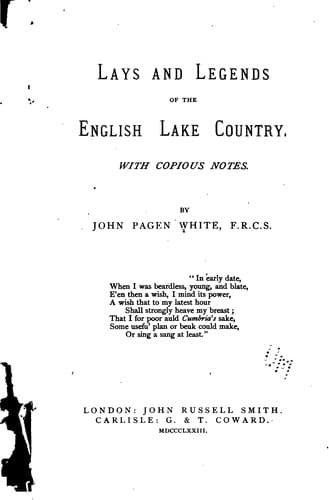
Lays and Legends of the English Lake Country: With Copious NotesWhite, John Pagen
General
Lays and Legends of the English Lake Country: With Copious Notes
White, John Pagen
Lake District (England) -- Poetry; Legends -- England -- Lake District
It has been conjectured that the colonization of this district by
the Northmen was effected at two distinct periods, by two separate
streams of emigration, issuing from two different parts of the
Scandinavian shore. The first recorded invasion of Cumberland by
the Danes appears to have taken place about the year 875; when an
army under the command of Halfdene, having entered Northumberland
and made permanent settlements there, commenced a series of
incursions into the adjacent countries lying on the north and
west, and thereby reached the borders of the lake region, first
plundering them and finally settling there. The indications of
the presence of the northern adventurers in that quarter are
found to be more purely of a Danish character than those which
abound beyond the eastern line of the district, and which may with
great probability be referred to a colonization more particularly
Norwegian.
Our own histories make no mention of anything bearing upon the
subject, but there seem to be good reasons for concluding that
Cumberland was also invaded from the sea coast. The Norwegian
sea-rover Olaf, according to Snorro Sturlessen, had visited, among
other countries, both Cumberland and Wales. And Mr. Ferguson
supposes, from various circumstances, which concur to fix the date
of the Norwegian settlements here in the interval between 945 and
1000, that his descents must have taken place somewhere about the
year 990. At that period the Cumbrian Britons had been for half
a century in subjugation to the Saxons, and since the death of
Dunmail their country had been handed over to Malcolm to be held in
fealty by the Scottish crown. The scattered remnants of the Celtic
tribes were for the most part shut up amongst their hills, or had
retired into Wales. The plains of Westmorland and Cumberland on
the north and east were probably chiefly occupied by a mixed Saxon
and Danish population; for nearly a century had elapsed since the
Danes from Northumberland had overrun them. In fifty years more the
result of events was, as we are informed by Henry of Huntingdon,
that one of the principal abodes of the "Danes," under which title
old writers comprehend all Northmen, was in Cumberland. A stream of
Northern emigrants, issuing, it may be supposed, from the districts
of the Tellemark, and the Hardanger, a name signifying "a place of
hunger and poverty," had descended along the north of Scotland,
swept the western side of the island, fixed its head-quarters in
the Isle of Man, and from thence succeeded in obtaining a firm
footing upon the opposite shore of England; a land, like their
own, of mountains and valleys, waiting for a people as they were
for a settlement, a wild and untamed country, always thinly
populated and never cultivated, a land of rocks and forests and of
desolation.
Public-domain text, read in full here on John Shaqi.
Reviews
Reviews
No reviews yet
Be the first to share your thoughts on this work.
Elsewhere in the archive
Join the Discussion
Join the discussion
Sign in to leave a comment or review.
Sign InorCreate an account