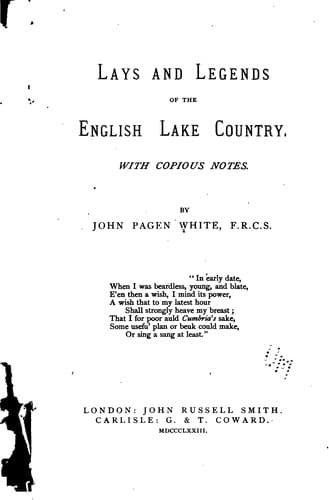
Lays and Legends of the English Lake Country: With Copious NotesWhite, John Pagen
General
Lays and Legends of the English Lake Country: With Copious Notes
White, John Pagen
Lake District (England) -- Poetry; Legends -- England -- Lake District
Such cures were held in these northern counties by unordained
persons, till about the middle of George II.'s reign; when the
Bishops came to a resolution, that no one should officiate who was
not in orders. But, because there would have been some injustice
and some hardship in ejecting the existing incumbents, they were
admitted to deacons' orders without undergoing any examination.
The person who was then Reader as it was called, at the Chapel in
the Vale of Newlands, and who received this kind of ordination,
exercised the various trades of Clogger, Tailor, and Butter-print
maker.
How otherwise than by following secular occupations were even
Readers to exist? The Chapel of "Secmurthow" on the south side of
the river Derwent, not far from the foot of Bassenthwaite lake,
was certified to the Governors of Queen Anne's Bounty at £2.,
being the interest of £40. raised by the inhabitants for a Reader.
"Before its augmentation," says Hutchinson, "the Reader of divine
service had a precarious income; but an actual custom existed for
several years of allowing the poor minister a _whittle-gate_. He
was privileged to go from house to house in the Chapelry, and stay
a certain number of days at each place, where he was permitted to
enter his _whittle_ or knife with the rest of the family. This
custom," he adds, "has been abolished in such modern times, that it
is in the memory of many now living." (i.e. 1794.)
The inhabitants of many of the Chapelries in the north got by
custom from the Rectors or Vicars the right of nominating and
presenting the curate; for this reason: before the death of Queen
Anne, many of the Chapelries were not worth above two or three
pounds a year, and the donees could not get persons properly
qualified to serve them; so they left them to the inhabitants,
who raised voluntary contributions for them in addition to their
salary, with clothes yearly and whittle-gate.
Clothes yearly, were one new suit of clothes, two pairs of shoes,
and one pair of clogs, shirts, stockings, etc., as they could
bargain.
Whittlegate is, to have two or three weeks' victuals at each house,
according to the ability of the inhabitants, which was settled
amongst them, so that he should go his course as regularly as the
sun, and complete it annually. Few houses having more knives than
one or two, the pastor was often obliged to buy his own; sometimes
it was bought for him by the chapel-wardens. He marched from house
to house with his whittle seeking fresh pasturage; and as master of
the herd, he had the elbow chair at the table-head, which was often
made of part of a hollow ash-tree, such as may be seen in those
parts at this day.
Public-domain text, read in full here on John Shaqi.
Reviews
Reviews
No reviews yet
Be the first to share your thoughts on this work.
Elsewhere in the archive
Join the Discussion
Join the discussion
Sign in to leave a comment or review.
Sign InorCreate an account