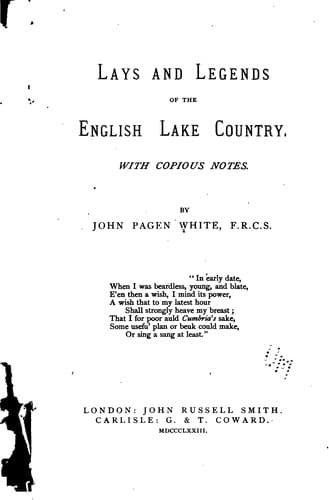
Lays and Legends of the English Lake Country: With Copious NotesWhite, John Pagen
General
Lays and Legends of the English Lake Country: With Copious Notes
White, John Pagen
Lake District (England) -- Poetry; Legends -- England -- Lake District
Buttermere was said to allow its priest whittle-gate, and twenty
shillings yearly; by other accounts, "clogg-shoes, harden-sark,
whittle-gate, and guse-gate"--that is, a pair of shoes clogged or
iron-shod, a shirt of coarse linen or hemp once a year, free-living
at each parishioner's house for a certain number of days, and the
right to pasture a goose or geese on the common.
The Wytheburn reader had sark, whittle-gate, and guse-gate.
The Mungrisdale priest had £6. 0_s._ 9_d._ a year.
Many worthies have appeared, nevertheless, among these unpretending
ministers of the dales; most prominently so, Robert Walker, for
a long period curate of Seathwaite, and surnamed for his many
virtues and industry, the Wonderful: of whose life and actions
an interesting and detailed account is given in the Notes in
Wordsworth's Works.
The Chapel of Martindale, a perpetual curacy under the vicarage
of Barton, near Penrith, was served for 67 years by a Mr. Richard
Birket. The ancient endowment was only £2. 15_s._ 4_d._ per annum,
a small house, and about four acres of land. At his first coming,
Birket's whole property consisted of two shirts and one suit of
clothes; yet he amassed a considerable sum of money. Being the only
man except one in the parish who could write, he transcribed most
of the law papers of his parishioners. Whenever he lent money,
he deducted at the time of lending, two shillings in the pound
for interest, and the term of the loan never exceeded a year.
He charged for writing a receipt twopence, and for a promissory
note fourpence; and used other means of extortion. He likewise
taught a school, and served as parish-clerk; and in both these
offices he showed his wonderful turn for economy and gain; for
his quarter-dues from his scholars being small, he had from the
parents of each scholar a fortnight's board and lodging; and
the Easter-dues being usually paid in eggs, he, at the time of
collecting, carried with him a board, in which was a hole that
served him as a gauge, and he positively refused to accept any
which would pass through. He got a fortune of £60 with his wife; to
whom he left at his decease the sum of £1200. Clark says, that on
account of transacting most of the law affairs of his parishioners,
he was called Sir Richard, or the Lawyer. But with reference to
this title, Nicholson, Bishop of Carlisle, at the beginning of the
18th century says, "Since I can remember, there was not a reader in
any chapel who was not called 'Sir.'" The old designation of the
clergy before the Reformation was always "Sir"; knight being added
as the military or civil distinction. It has also been stated that
the last curate of this parish, or of these parts at all, called
"Sir," was the Reverend Richard Birket (apud 1689).
Public-domain text, read in full here on John Shaqi.
Reviews
Reviews
No reviews yet
Be the first to share your thoughts on this work.
Elsewhere in the archive
Join the Discussion
Join the discussion
Sign in to leave a comment or review.
Sign InorCreate an account