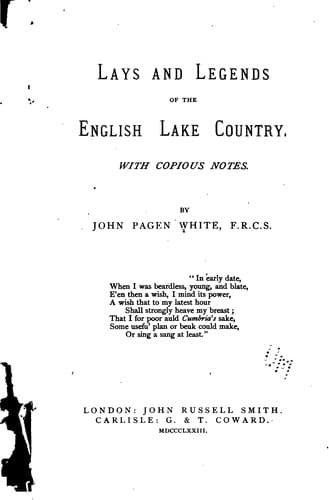
Lays and Legends of the English Lake Country: With Copious NotesWhite, John Pagen
General
Lays and Legends of the English Lake Country: With Copious Notes
White, John Pagen
Lake District (England) -- Poetry; Legends -- England -- Lake District
It is said of Whitbeck Chapel, which lies on the base of Black
Combe, near the sea shore, that smugglers frequenting that exposed
part of the coast, on many occasions deposited their illegal
cargoes within its walls, until a convenient opportunity arose
for removing them unobserved. Sunday sometimes came round when
the sacred edifice was not in the most suitable condition for
celebrating divine service. The parish clerk had then to advise
the minister that it would be inconvenient to officiate on that
day. It was not politic to scrutinize too closely the nature of
the difficulty that existed: it was sufficiently understood. A
substantial sample of the intruding contraband element found its
way to the house of the minister; and forthwith due notice was
circulated among the parishioners that the usual service would
not be held until the Sunday following. Meanwhile the stores were
disposed of, and the wild and desperate adventurers were in full
career again towards the Manx or Scottish shore.
In 1300 the Lady of Allerdale, and of the Honour of Cockermouth,
Isabel Countess of Albemarle was summoned to prove by what right
she held a market at Crosthwaite (near Keswick). She denied
that she held any market there, but said that the men of the
neighbourhood met at the Church on Festival days, and there sold
flesh and fish; and that she as lady of the Manor of Derwent Fells
took no toll. This practice being persevered in, in 1306 the
inhabitants of Cockermouth represented in a petition to parliament
that there was a great concourse of people every Sunday at
Crosthwaite Church, where corn, flour, beans, peas, linen, cloth,
meat, fish, and other merchandise were bought and sold, which was
so very injurious to the market at Cockermouth, that the persons
of that place who farmed the tolls of the king were unable to pay
their rent. Upon this a prohibitory proclamation was issued against
the continuance of such an unseemly usage.
Public-domain text, read in full here on John Shaqi.
Reviews
Reviews
No reviews yet
Be the first to share your thoughts on this work.
Elsewhere in the archive
Join the Discussion
Join the discussion
Sign in to leave a comment or review.
Sign InorCreate an account