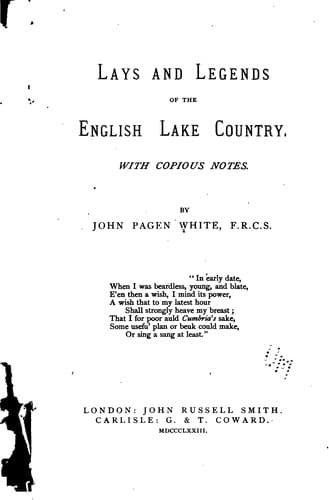
Lays and Legends of the English Lake Country: With Copious NotesWhite, John Pagen
General
Lays and Legends of the English Lake Country: With Copious Notes
White, John Pagen
Lake District (England) -- Poetry; Legends -- England -- Lake District
Things had not got quite straight in this respect within the
sanctuary at a much later period. The Rev. Thos. Warcup, incumbent
of the parish church of Wigton, in the civil war was obliged to fly
on account of his loyalty to the sovereign. After the restoration
of Charles II. he returned to his cure; and tradition says, that
the butcher-market was then held upon the Sunday, and the butchers
hung up their carcasses even at the church door, to attract the
notice of their customers as they went in and came out of church;
and it was not an unfrequent thing to see people, who had made
their bargains before prayer began, hang their joints of meat over
the backs of the seats until the pious clergyman had finished the
service. The zealous priest, after having long, but ineffectually,
endeavoured to make his congregation sensible of the indecency of
such practices, undertook a journey to London, on foot, for the
purpose of petitioning the king to have the market-day established
on the Tuesday; which favour it is said he had interest enough to
obtain.
This faithful priest long before his death caused his own monument
to be erected in the churchyard, with this inscription in verse of
his own composing:
Thomas Warcup prepar'd this stone,
To mind him of his best home.
Little but sin and misery here,
Till we be carried on our bier.
Out of the grave and earth's dust,
The Lord will raise me up, I trust;
To live with Christe eternallie,
Who, me to save, himself did die.
Mihi est Christus et in vita et in morte lucrum. Phil. i. 21.
Obiit anno 1653.
Thus it appears his decease did not take place until some years
after the date at which he records his death; probably a period
marked by some important change in his life, or of unusual
solemnity reminds us that only thirty-five years ago, at a very few
miles from its base, one who served the pastoral office more than
fifty years, eking out a wretched maintenance upon a small farm;
while his sons were at the plough, was of necessity compelled to
send his daughters with horses and carts for coals and lime, and to
lead manure to the fields and distribute it over the land; whilst
the Dean and Chapter of his diocese were the patrons of his cure.
Such things can hardly be witnessed at this day. But a minister may
be seen even now (1867) on the other side of the district, leading
the choir in the aisle, in his surplice, with bow and fiddle in
his hands, and then resuming his place at the desk, with becoming
solemnity, until the course of the service requires his instrument
again. His sense of harmony is acute; for in the middle of the
psalm, his arms will fly apart, and the volume of sound be stopped,
until an offensive note has been ejected, and the strain rectified,
and renewed.
Public-domain text, read in full here on John Shaqi.
Reviews
Reviews
No reviews yet
Be the first to share your thoughts on this work.
Elsewhere in the archive
Join the Discussion
Join the discussion
Sign in to leave a comment or review.
Sign InorCreate an account