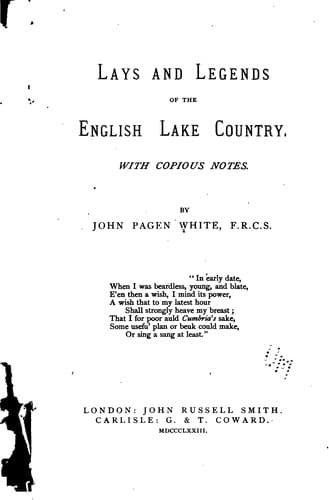
Lays and Legends of the English Lake Country: With Copious Notes — John Shaqi
Lays and Legends of the English Lake Country: With Copious NotesWhite, John Pagen
General
Lays and Legends of the English Lake Country: With Copious Notes
White, John Pagen
Lake District (England) -- Poetry; Legends -- England -- Lake District
In this deep retreat the inhabitants of the villages of Rosthwaite
and Seathwaite, having at all times little intercourse with the
country, during half the year were almost totally excluded from all
human commerce. The surrounding hills attract the vapours, and rain
falls abundantly; snow lies long in the valleys; and the clouds
frequently obscure the sky. Upon the latter village, in the depth
of winter, the sun never shines. As the spring advances, his rays
begin to shoot over the southern mountains; and at high noon to
tip the chimney tops with their light. That radiant sign shows the
cheerless winter to be now over; and rouses the hardy peasants to
the labours of the coming year. Their scanty patches of arable land
they cultivated with difficulty; and their crops late in ripening,
and often a prey to autumnal rains, which are violent in this
country, just gave them bread to eat. Their herds afforded them
milk; and their flocks supplied them with clothes: the shepherd
himself being often the manufacturer also. No dye was necessary to
tinge their wool: it was naturally a russet brown; and sheep and
shepherds were clothed alike, both in the simple livery of nature.
The procuring of fuel was among their greatest hardships. Here the
inhabitants were obliged to get on the tops of the mountains; which
abounding with mossy grounds, seldom found in the valleys below,
supplied them with peat. This, made into bundles, and fastened upon
sledges, they guided down the precipitous sides of the mountains,
and stored in their outbuildings. At the period to which we refer,
a hundred years ago, the roads were of the rudest construction,
scarcely passable even for horses. A cart or any kind of wheeled
carriage was totally unknown in Borrodale. They carried their hay
home upon their horses, in bundles, one on each side: they made no
stacks. Their manure they carried in the same manner, as also the
smaller wood for firing: the larger logs they trailed. Their food
in summer consisted of fish and small mutton; in winter, of bacon
and hung mutton. Nor was their method of drying their mutton less
rude: they hung the sheep up by the hinder legs, and took away only
the head and entrails. In this situation, I myself, says Clarke,
have seen seven sheep hanging in one chimney.
Public-domain text, read in full here on John Shaqi.
Reviews
Reviews
No reviews yet
Be the first to share your thoughts on this work.
Join the Discussion
Join the discussion
Sign in to leave a comment or review.
Sign InorCreate an account