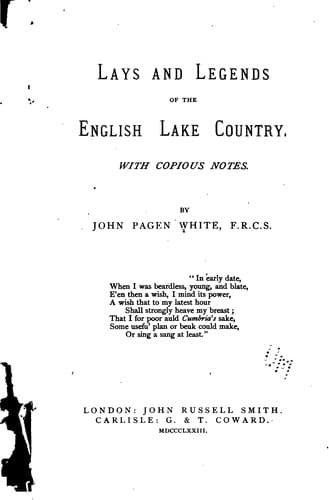
Lays and Legends of the English Lake Country: With Copious NotesWhite, John Pagen
General
Lays and Legends of the English Lake Country: With Copious Notes
White, John Pagen
Lake District (England) -- Poetry; Legends -- England -- Lake District
In allusion to which, Mr. Tomlinson the editor and translator of
the MS. observes that "this is another of those marks of dependence
of the surrounding chapelries which formerly existed; a mark the
more interesting because to this day some traces of it remain.
Communicants still annually resort to the church of St. Bees at the
festival of Easter from considerable distances; and the village
presents an unusual appearance from their influx; and at the church
the eucharist is administered as early as eight in the morning,
in addition to the celebration of it at the usual time. There can
be no doubt but that Whitsuntide, and perhaps Christmas, as well
as Easter, were formerly seasons when the church of St. Bees was
resorted to by numbers who appeared within it at no other time,
save perhaps at the burial of their friends. The great festivals
of the church appear in the middle ages to have been considered
by the English as peculiarly auspicious for the solemnization of
marriages. At these seasons then, from concurring causes, the
long-drawn solemn processions of priests and people would be
chiefly seen, and then also, the accustomed oblations of the latter
to the mother church of St. Bees would be discharged."
As to the "town and haven of Whitehaven" included in the gift to
"St. Bees Abbie," its eligibility as a fishing ground, when the
tides ran nearer the meadows than at present, would doubtless
attract the attention of the monks of St. Bees; and the fact of
its being denominated _Whittofthaven_, _Quitofthaven_, _Wythoven_,
_Whyttothaven_, _Whitten_, &c., in the register of St. Bees and
other ancient records, evidently shows that it is a place of
greater antiquity than has generally been ascribed to it; and some
fragments of tradition, still extant, seem to countenance this
opinion.
Denton (MS.) speaking of Whitehaven or White-Toft Haven, says
"It was belonging to St. Beghs of antient time, for the Abbot
of York, in Edward I.'s time was impleaded for wreck, and his
liberties there, by the King, which he claimed from the foundation,
to be confirmed by Richard Lucy, in King John's time, to his
predecessors."
Public-domain text, read in full here on John Shaqi.
Reviews
Reviews
No reviews yet
Be the first to share your thoughts on this work.
Elsewhere in the archive
Join the Discussion
Join the discussion
Sign in to leave a comment or review.
Sign InorCreate an account