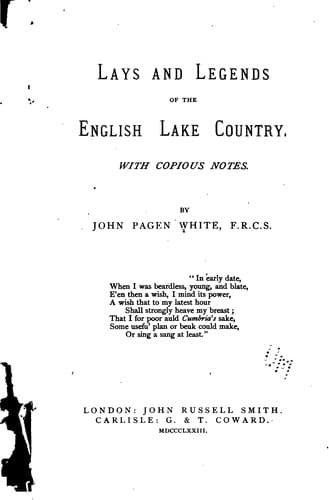
Lays and Legends of the English Lake Country: With Copious NotesWhite, John Pagen
General
Lays and Legends of the English Lake Country: With Copious Notes
White, John Pagen
Lake District (England) -- Poetry; Legends -- England -- Lake District
That Whitehaven was anciently a place of resort for shipping
appears from some particulars respecting it mentioned in those
remarkable Irish documents, called the _Annals of the Four
Masters_, much of which was written at the Abbey of Monesterboice,
in the county of Louth--nearly opposite, on the Irish shore. In the
account of the domestic habits and manufactures of the Irish, it
is stated that their _coracles_, or _Wicker Boats_, their Noggins,
and other domestic utensils, were made of wood called _Wythe_ or
_Withey_, brought from the opposite shore of _Baruch_ (i.e. rocky
coast) and that a small colony was placed there for the purpose
of collecting this wood. That Barach mouth, or Barrow mouth, and
Barrow mouth wood is the same as that alluded to by the Four
Masters, is evident from the legend of St. Bega, which places it
in the same locality; and that the colony of Celts resided in the
neighbourhood of the now _Celts_, or _Kell's Pit_, in the same
locality also, is manifest from the name. About the year 930, it
appears that one of the Irish princes or chiefs, accompanied an
expedition to this place for wood (for that a great portion of
the site of the present town and the neighbouring heights were
formerly covered with forest trees there can be no doubt) and that
the inhabitants who were met at _Whitten_, or _Wittenagemote_, fell
upon and look the chief and several of the accompanying expedition
prisoners from a jealousy of their sanctuary being invaded. Many
of the Irish utensils were imported hither, particularly the
_noggin_, or small water pail, which was made of closely woven
wickerwork, and covered inside with skin, having a projecting
handle for the purpose of dipping into a river or well. The same
article, in its primitive shape, though made of a different
material, called a _geggin_, is still used by some of the farmers
in that neighbourhood. When _Adam de Harris_ gave lands at Bransty
Beck to the church of Holm Cultram, he also gave privilege to the
monks to cut wood for making geggins or noggins.
From an old history of the county of Durham, Whitehaven appears
to have been a resort for shipping in the tenth century; and when
the Nevills of Raby were called upon to furnish their quota of
men to accompany Henry in his expedition to Ireland in 1172, they
were brought to _Wythop-haven_, or _Witten-haven_, and transported
thence in ships to the Irish coast. When Edward was advancing
against Scotland, in the fourteenth century, he found a ship
belonging to this place, in which he sent a cargo of oats, to be
ground by the monks of St. Bees.
Public-domain text, read in full here on John Shaqi.
Reviews
Reviews
No reviews yet
Be the first to share your thoughts on this work.
Elsewhere in the archive
Join the Discussion
Join the discussion
Sign in to leave a comment or review.
Sign InorCreate an account