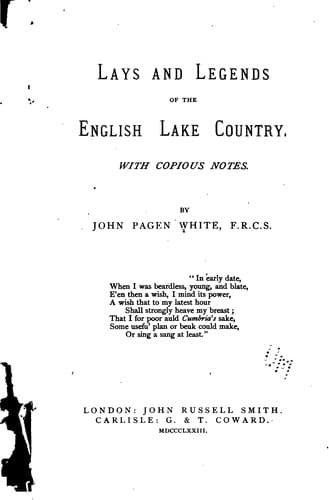
Lays and Legends of the English Lake Country: With Copious NotesWhite, John Pagen
General
Lays and Legends of the English Lake Country: With Copious Notes
White, John Pagen
Lake District (England) -- Poetry; Legends -- England -- Lake District
In nearly all histories of Cumberland, the name of Whitehaven has
been attributed either to some imaginary whiteness of the rocks
on the east side of the harbour, or to the cognomen of an old
fisherman who resided there about the year 1566, at which time the
town is said to have had only six houses. In 1633 it consisted of
only nine thatched cottages. Sir Christopher Lowther, second son
of Sir John Lowther, purchased Whitehaven and the lands lying in
its neighbourhood, and built a mansion on the west end of the haven
at the foot of a rock. He died in 1644, and was succeeded by his
son, Sir John Lowther, who erected a new mansion on the site of the
present castle, described by Mr. Denton, in 1688, as a "stately
new pile of building, called the Flatt," and having conceived the
project of working the coal mines, and improving the harbour, he
obtained from Charles the Second, about the year 1666, a grant
of all the "derelict land at this place," which yet remained in
the crown; and in 1678, all the lands for two miles northward,
between high and low water mark, the latter grant containing about
150 acres. Sir John having thus laid the foundation of the future
importance of Whitehaven, commenced his great work, and lived to
see a small obscure village grow up into a thriving and populous
town.
There is a traditionary account of the existence of an ancient ruin
where the castle stands (probably Druidical; or, where at a later
period, the Whitten, or Wittenagemote, was held) the remains of
which were broken up about the year 1628. Respecting these real or
imaginary stones it has been related, that the inhabitants believed
them to be enchanted warriors, and gave them the appellation
of "_Dread Ring_, or _Circle_," and occasionally "_Corpse
Circle_"--corrupted into the word _Corkickle_, the name which the
locality now bears.
A reminiscence of the old mansion of the Lowthers is preserved by
the road which skirts the precincts of the castle. This is still
called, by the older townspeople, the Flatt Walk.
CREWL-WORK.
_Krull_, or _Crewel_, is a word evidently derived from the old
Norse _Krulla_, signifying to blend, to mix, and also to curl; in
fact, "crewel" work is embroidery, the Berlin wool work of modern
days; but the word is generally applied, in this locality, to the
covering of a hand ball with worsted work of various colours and
devices, the tribute of mothers and sisters in our boyhood.
FOOTNOTES:
[3] See Note on page 80.
[4] Advenerat annua revolutione quædam celebritas quam sacro sancto
sabbato in vigilia pentecosten homines illius terræ ob quædam insignia
sanctitatis sanctæ virginis tunc illic inventa, et signa ibidem
perpetrata solent solempnizare; et ecclesiam illius visitando orationum
et oblationum hostiis honorare.
Vita S. Begæ, et de Miraculis Ejusdem, p. 73.
Public-domain text, read in full here on John Shaqi.
Reviews
Reviews
No reviews yet
Be the first to share your thoughts on this work.
Elsewhere in the archive
Join the Discussion
Join the discussion
Sign in to leave a comment or review.
Sign InorCreate an account