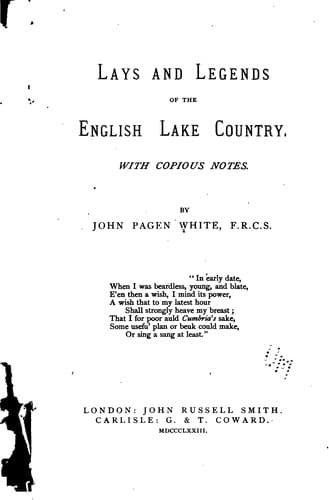
Lays and Legends of the English Lake Country: With Copious NotesWhite, John Pagen
General
Lays and Legends of the English Lake Country: With Copious Notes
White, John Pagen
Lake District (England) -- Poetry; Legends -- England -- Lake District
And there where both were 'reft of life,
And both were victors in the strife,
Survives this saying on that chase,
In memory of their famous race--
"Here Hercules killed Hart-of-Grease,
And Hart-of-Grease killed Hercules."
NOTES TO "HART'S-HORN TREE."
I.--The memorable Westmorland Forest, or Park of Whinfell,
anciently written Qwynnefel, was a grant to Robert de Veteripont
from King John. This grant restrained him from committing waste in
the woods, and from suffering his servants to hunt there in his
absence during the king's life. Till the beginning of last century
it was famous for its prodigious oaks; a trio of them, called The
Three Brothers, were the giants of the forest; and a part of the
skeleton of one of them, called _The Three Brothers' Tree_, which
was thirteen yards in girth, at a considerable distance from the
root, was remaining until within a very recent period.
On the east side of this park is Julian's Bower, famous for its
being the residence of Gillian, or Julian, the peerless mistress of
Roger de Clifford, about the beginning of the reign of Edward III.
The Pembroke memoirs call it "a little house hard by Whinfell-park,
the lower foundations of which standeth still, though all the wall
be down long since." This record also mentions the Three Brother
Tree and Julian's Bower, as curiosities visited by strangers in
the Countess of Pembroke's time, prior to which a shooting seat
had been erected near these ruins, for she tells us, that her
grandson, Mr. John Tufton, and others at one time, "alighted on
their way over _Whinfield_ park at Julian's Bower, to see all the
rooms and places about it." Its hall was spacious, wainscotted,
and hung round with prodigious stags' horns, and other trophies of
the field. One of the rooms was hung with very elegant tapestry;
but since it was converted into a farm-house all these relics of
ancient times have been destroyed.
A large portion of the park was divided into farms in 1767; and
the remainder in 1801, when its deer were finally destroyed. It
was thus stripped of its giant trees, and consigned to its present
unsheltered condition.
Public-domain text, read in full here on John Shaqi.
Reviews
Reviews
No reviews yet
Be the first to share your thoughts on this work.
Elsewhere in the archive
Join the Discussion
Join the discussion
Sign in to leave a comment or review.
Sign InorCreate an account