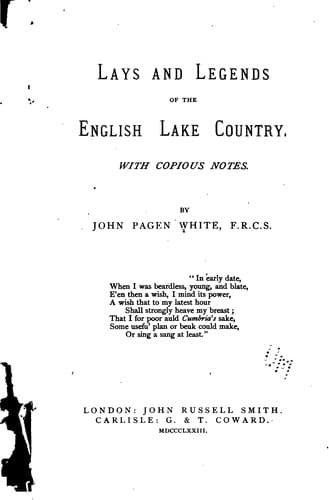
Lays and Legends of the English Lake Country: With Copious NotesWhite, John Pagen
General
Lays and Legends of the English Lake Country: With Copious Notes
White, John Pagen
Lake District (England) -- Poetry; Legends -- England -- Lake District
The situation of Furness Abbey, in Bekan's Ghyll, justifies the
choice of its first settlers. The approach from the north is such
that the ruins are concealed by the windings of the glen, and the
groves of forest trees which cover the banks and knolls with their
varied foliage: but unluckily it has been thought necessary to
disturb the solitude of the place by driving a railway through
it, within a few feet of the ruins, and erecting a station upon
the very site of the Abbot's Lodge. A commodious road from Dalton
enters this vale, and crossing a small stream which glides along
the side of a fine meadow, branches into a shaded lane which leads
directly to the ruins of the sacred pile. The trees which shade
the bottom of the lane on one side, spread their bending branches
over an ancient Gothic arch, adorned with picturesque appendages
of ivy. This is the principal entrance into the spacious enclosure
which contains the Monastery. The building appertaining to it took
up the whole breadth of the vale; and the rock from whence the
stones were taken, in some parts made place for and overtopped
the edifice. Hence it was so secreted, by the high grounds and
eminences which surround it, as not to be discovered at any
distance. The Western Tower must have originally been carried to
a very considerable height, if we judge from its remains, which
present a ponderous mass of walls, eleven feet in thickness,
and sixty feet in elevation. These walls have been additionally
strengthened with six staged buttresses, eight feet broad, and
projecting nine feet and a half from the face of the wall; each
stage of which has probably been ornamented like the lower one now
remaining, with a canopied niche and pedestal. The interior of the
tower, which measures twenty-four feet by nineteen feet, has been
lighted by a fine graceful window of about thirty feet in height,
by eleven and a half in width; the arch of which must have been
beautifully proportioned. A series of grotesque heads, alternating
with flowers, is introduced in the hollow of the jambs, and the
label terminates in heads. On the right side of the window is a
loophole, admitting light to a winding staircase in the south-west
angle of the tower, by which its upper stories might be ascended,
the entrance to the stairs being by a door, having a Tudor arch,
placed in an angle of the interior. The stairs are yet passable,
and the view from the top is worth the trouble of an ascent.
Public-domain text, read in full here on John Shaqi.
Reviews
Reviews
No reviews yet
Be the first to share your thoughts on this work.
Elsewhere in the archive
Join the Discussion
Join the discussion
Sign in to leave a comment or review.
Sign InorCreate an account