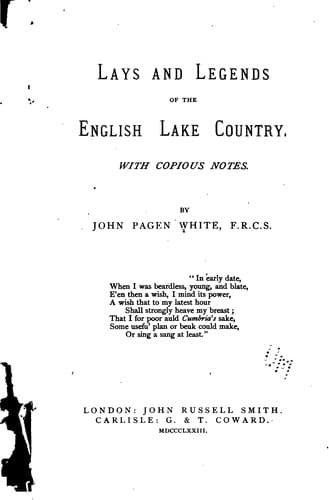
Lays and Legends of the English Lake Country: With Copious NotesWhite, John Pagen
General
Lays and Legends of the English Lake Country: With Copious Notes
White, John Pagen
Lake District (England) -- Poetry; Legends -- England -- Lake District
The workmen employed by the late Lord G. Cavendish, state that
the rubbish in this tower, accumulated by the fall of the
superstructure, which filled up the interior to the window sill,
was rendered so compact by its fall, so tenacious by the rains, and
was composed of such strongly cemented materials, as to require
blasting with gunpowder into manageable pieces for its removal.
Prior to its clearance, it was the scene of some marvellous tales
disseminated and credited by many, who alleged that this heap
covered a vault to which the staircase led, containing the bells
and treasure of the abbey, with the usual accompaniments of the
White Lady, at whose appearance the lights were extinguished, the
impenetrable iron-grated door, and the grim guardian genius. Though
many essayed, none were known to have succeeded in the discovery
of this concealed treasure house, much less of its contents. The
inhabitants of the manor house, on one occasion, were roused
from their slumbers by a noise proceeding from the ruins, and on
hastening to the spot, discovered that it was made by some scholars
from the neighbouring town of Dalton, digging among the ruins at
midnight, in quest of the buried spoils.
Within the inner enclosure, on the north side of the Church at St.
Mary's Abbey in Furness, a few tombstones lie scattered about in
what has formerly been a part of the cemetery. One of these bears
the inscription, partly defaced,
HIC JACET ANA F.. ... ......TI FLANDREN...,
and commemorates one of the ancient family of Le Fleming.
Michael Le Fleming, the first of the name, called also Flemengar,
and in some old writings Flandrensis, was kinsman to Baldwin,
Earl of Flanders, father-in-law to the Conqueror; by whom he was
sent with some forces to assist William in his enterprise against
England.
After the Conquest was completed, and William was seated on the
throne of England, the valiant Sir Michael, for his fidelity,
and good services against the Saxons and Scots, received from
his master many noble estates in Lancashire; Gleaston, and the
manor of Aldingham, with other lands in Furness. William de
Meschines also granted him Beckermet Castle, vulgarly at that time
called Caernarvon Castle, with the several contiguous manors of
Frizington, Rottington, Weddaker, and Arloghden, all in Cumberland.
Public-domain text, read in full here on John Shaqi.
Reviews
Reviews
No reviews yet
Be the first to share your thoughts on this work.
Elsewhere in the archive
Join the Discussion
Join the discussion
Sign in to leave a comment or review.
Sign InorCreate an account