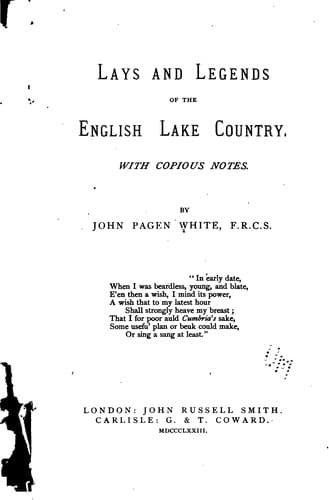
Lays and Legends of the English Lake Country: With Copious NotesWhite, John Pagen
General
Lays and Legends of the English Lake Country: With Copious Notes
White, John Pagen
Lake District (England) -- Poetry; Legends -- England -- Lake District
Pale hollow forms in suits of woe
Appear'd like gleams to come and go.
And wreathed in mists was seen to rest
A 'scutcheon on Blencathra's breast.--
Full soon the speeding tidings came.
The Earl had died the death of fame,
By axe and block, on bended knee,
For true-love, faith, and loyalty.
And still, when o'er the Isles return
The Northern lights to blaze and burn;
The vales and hills repeat the moan
For him the good Earl slain and gone.
NOTES TO "LORD DERWENTWATER'S LIGHTS."
Lord's Island, in Keswick Lake, is memorable as having been the
home of James Radcliffe, third and last Earl of Derwentwater,
whose life and great possessions were forfeited in 1716, in the
attempt to restore the royal line of Stuart to the throne, and
whose memory is affectionately cherished in the north of England.
An eminence upon its shores, called Castle-Rigg, which overlooks
the vale of Keswick, was formerly occupied by a Roman fort, and
afterwards by the stronghold of the Norman lords, who were called,
from the locality of this their chief residence, de Derwentwater.
Their early history is wrapt in obscurity; but their inheritance
comprised the greater part of the parish of Crosthwaite, in
addition to possessions in other parts of Cumberland, and in other
counties. These became vested in the Radcliffe family in the reign
of Henry the Fifth, by the marriage of Margaret daughter and
heiress of Sir John de Derwentwater, with Sir Nicholas Radcliffe,
of lineage not less ancient than that of his wife, he being of
Saxon origin, and of a family which derived its name from a
village near Bury in Lancashire. In later time the Norman tower on
Castle-Rigg was abandoned, and its materials are said to have been
employed in building the house upon that one of the three wooded
islands in the lake, which is called Lord's Island, and upon which
the Radcliffe family had a residence. This island was originally
part of a peninsula; but when the house was built, it was separated
from the main land by a ditch or moat, over which there was a
draw-bridge, and the approaches to this may still be seen. Of
the house itself, little more than the moss-covered foundations
remain. The stones, successively, of the Roman Castrum, of the
Norman Tower, and of the lord's residence, are said to have been
subsequently used in building the town-hall of Keswick.
Public-domain text, read in full here on John Shaqi.
Reviews
Reviews
No reviews yet
Be the first to share your thoughts on this work.
Elsewhere in the archive
Join the Discussion
Join the discussion
Sign in to leave a comment or review.
Sign InorCreate an account