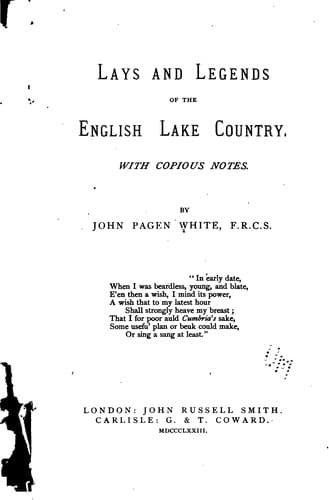
Lays and Legends of the English Lake Country: With Copious NotesWhite, John Pagen
General
Lays and Legends of the English Lake Country: With Copious Notes
White, John Pagen
Lake District (England) -- Poetry; Legends -- England -- Lake District
The estate of the Derwentwater family seems to have originally
extended along the shores of the lake for nearly two miles, and
for a mile eastward of the shore. On one side of it lies the
present road from Keswick to Ambleside, on the other its boundary
approached Lodore, whilst the crest of Walla Crag, divided it
from the common. There, surrounded by a combination of grandeur
and beauty which is almost unrivalled in this country, the
Knightly ancestors of James Radcliffe, the third and last Earl of
Derwentwater, whose virtues and whose fate have encircled his name
with traditional veneration, had their paternal seat.
This chivalrous and amiable young nobleman was closely allied by
blood to the Prince Edward, afterwards called "the Pretender," in
whose cause he fell a sacrifice; his mother, the Lady Mary Tudor,
a natural daughter of King Charles II. and Mrs. Davis, being first
cousin to the Prince. He was nearly the same age as the Prince,
being one year younger: and in his early childhood was taken to
France to be educated, when James the Second and his consort were
living in exile at St. Germain's, surrounded, however, by the noble
English, Scottish, and Irish emigrant royalists, who followed the
fortunes of their dethroned monarch. The sympathies of his parents
having also led them thither, the youthful heir of Derwentwater
was brought up with the little Prince, at St. Germain's, sharing
his infantine pleasures and pastimes, and occasionally joining his
studies under his governess the Countess of Powis. A friendship
thus formed in youth, nurtured by consanguinity, strengthened by
ripening age, and cemented by the extraordinary good qualities of
the young nobleman, and his power to win affection and esteem,
culminated in that attachment and devotion to the cause of his
Prince and friend, which terminated only with his life.
The Earl appears to have visited Dilston, his ancestral home in
Northumberland, for the first time in 1710, when he was in his
twenty-first year; and in the spring of the same year he spent
some time on the Isle of Derwent, where the ancient mansion of the
Radcliffes was then standing. During a considerable portion of the
two next succeeding years, his chief residence appears to have been
at Dilston, where he lived in the constant exercise of hospitality,
and in the practice of active benevolence towards not only the
peasantry on his wide estates, but all who needed his assistance,
whether known to him or not, and whether Papist or Protestant. He
seems to have taken great delight in rural pursuits, and in the
pleasures of the chase, and in the charms of nature by which he
was surrounded.
Public-domain text, read in full here on John Shaqi.
Reviews
Reviews
No reviews yet
Be the first to share your thoughts on this work.
Elsewhere in the archive
Join the Discussion
Join the discussion
Sign in to leave a comment or review.
Sign InorCreate an account