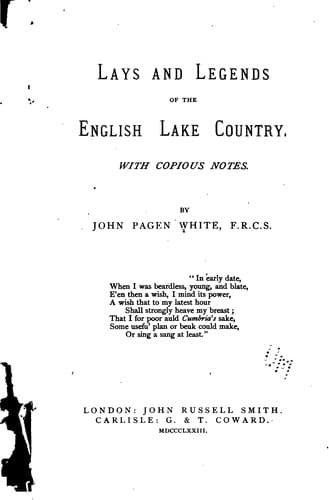
Lays and Legends of the English Lake Country: With Copious NotesWhite, John Pagen
General
Lays and Legends of the English Lake Country: With Copious Notes
White, John Pagen
Lake District (England) -- Poetry; Legends -- England -- Lake District
Early in October it was represented to the Earl that the adherents
of the exiled Prince were ready to appear in arms, and to be only
waiting for him and his brother to join them. It would appear
that at this critical moment, the Earl, influenced by many
considerations, personal and domestic, as well as prudential,
wavered in his resolution; and tradition avers that, on stealthily
revisiting Dilston Hall, his Countess reproached him for continuing
to hide his head in hovels from the light of day, when the gentry
were in arms for their rightful sovereign; and throwing down her
fan before her lord, told him in cruel raillery to take it, and
give his sword to her. Something of this feeling is attributed to
her in the old ballad poem entitled "Lord Derwentwater's Farewell,"
wherein the following lines are put into his mouth:--
"Farewell, farewell, my lady dear:
Ill, ill thou counselled'st me:
I never more may see the babe
That smiles upon thy knee."
The popular notion that the Earl was driven into his fatal
enterprise by the persuasions of his lady is evidently here
referred to. But the amiable and gentle character of the Countess,
that affectionate and devoted wife, whom the Earl in his latest
moments declared to be all tenderness and virtue, and to have
loved him constantly, is a sufficient refutation of the popular
opinion, which does so much injustice to her memory. Nevertheless
there is historical reason for believing that the Earl did suddenly
decide on joining the Prince's friends, who were then in arms;
and his lady's persuasions may have contributed to that fatal
precipitation. On the 6th of October, the little force of horse
and men, consisting of his own domestic levy, was assembled in the
courtyard of his castle; arms were supplied to them; the Earl, his
brother, and the company, crossed the Devil's Water at Nunsburgh
Ford; and the fatal step was irrevocably taken. Old ladies of the
last century used to tell of occurrences of evil omen which marked
the departure of the devoted young nobleman from the home of his
fathers, to which he was destined never to return; how on quitting
the courtyard, his favourite dog howled lamentably; how his horse,
the well-known white or dapple gray, associated with his figure
in history and poetry, became restive, and could with difficulty
be urged forward; and how he soon afterwards found that he had
lost from his finger a highly prized ring, the gift of his revered
grandmother, which he constantly wore.
Public-domain text, read in full here on John Shaqi.
Reviews
Reviews
No reviews yet
Be the first to share your thoughts on this work.
Elsewhere in the archive
Join the Discussion
Join the discussion
Sign in to leave a comment or review.
Sign InorCreate an account