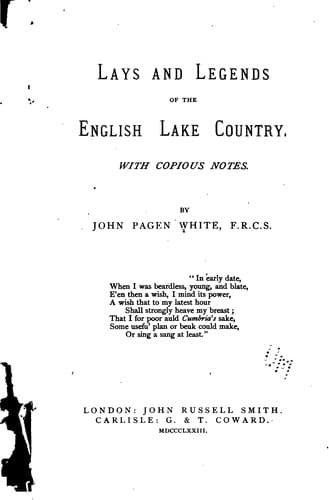
Lays and Legends of the English Lake Country: With Copious NotesWhite, John Pagen
General
Lays and Legends of the English Lake Country: With Copious Notes
White, John Pagen
Lake District (England) -- Poetry; Legends -- England -- Lake District
It is not necessary to dwell upon the details of this unfortunate
and ill-conducted enterprise, in the course of which James III.
was proclaimed in town and village, in Warkworth and Alnwick, in
Penrith and Appleby, Kendal and Lancaster, to the final catastrophe
of the little band at Preston. There, hemmed in by the government
troops, the brave and devoted friends of the royal exiles, who
had been led into this premature effort contrary to their better
judgments, and went forth with a determined loyalty which good or
bad report could not subdue, saw reason to regret, when too late,
their misplaced confidence in their leaders. Already they saw
themselves about to be sacrificed to the divided counsels of their
comrades and the incapacity of Foster, their general. Defensive
means imperfectly planned, and hastily carried out, enabled them
to hold the approaches to the town for three or four days against
the Brunswickers, whom they gallantly repulsed, in a determined
attack upon their barricades. But overmatched by disciplined
troops; out-generalled, and out-numbered; and finding resistance
to be unavailing; on the morning of Monday the 14th of October
they surrendered at discretion to the forces sent to oppose them.
Being assembled in the market place to the number of 1700, they
delivered up their arms, and became prisoners. The young Earl was
sent to London, which he reached on the 9th of December, and was
conducted to the Tower on the capital charge of high treason.
Unavailing efforts were made by his wife and friends to save him.
It appears that on the 20th of February his life was offered to him
by two noblemen who came to him in the tower, in the name of the
King, if he would acknowledge the title of George I. and conform to
the Protestant religion: but these terms were refused by him. The
offer of his life and fortune was repeated on the scaffold, but he
answered that the terms "would be too dear a purchase." The means
proposed to him, he looked upon as "inconsistent with honour and
conscience, and therefore I rejected them." He went to the block
with firmness and composure: and his behaviour was resolute and
sedate. In an address which he delivered on the scaffold, he said
"If that Prince who now governs had given me my life, I should have
thought myself obliged never more to have taken up arms against
him." And the axe closed, by a "violent and vengeful infliction,"
the brief career of the beloved, devoted, and generous Earl of
Derwentwater. He was twenty-seven years of age.
Public-domain text, read in full here on John Shaqi.
Reviews
Reviews
No reviews yet
Be the first to share your thoughts on this work.
Elsewhere in the archive
Join the Discussion
Join the discussion
Sign in to leave a comment or review.
Sign InorCreate an account