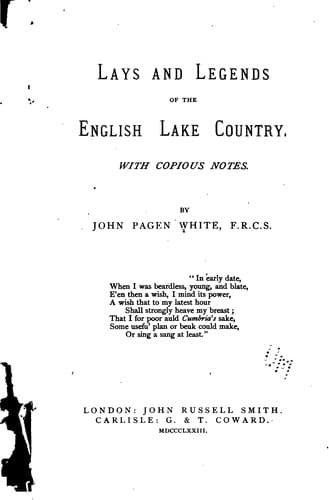
Lays and Legends of the English Lake Country: With Copious NotesWhite, John Pagen
General
Lays and Legends of the English Lake Country: With Copious Notes
White, John Pagen
Lake District (England) -- Poetry; Legends -- England -- Lake District
"As I know nobody is more ready to serve a friend than yourself,
I desire the favour you will keep my gray horse for me, till we
see what will be done relating to horses. I believe they will be
troublesome, for it is said the D. of Ormond is gone from his
house. God send us peace and good neighbourhood,--unknown blessings
since I was born. Pray ride my horse about the fields, or any where
you think he will not be known, and you will oblige, Sir, your
humble servant,
"DERWENTWATER."
"He is at grass."
In the first sentence the reference is made to the jealous penal
regulation, which forbade a Roman Catholic to possess a noble animal of
height and qualities suited to military equipment.
From tradition preserved in the family of Mr. Hunter of Medomsley,
the person addressed, there is every reason to believe that the gray
horse mentioned in the above letter, was the identical steed which was
brought by the son of Mr. Hunter to Bywell, and taken thence by Lord
Derwentwater's servant to Hexham for his lordship's use; and upon which
the devoted Earl rode from Hexham, with the gallant champions of the
Prince's right, on the 19th of October following.
A man named Cuthbert Swinburn, then 90 years of age, who was born at
Upper Dilston, and whose family resided there for some generations,
related to a correspondent of W. S. Gibson, Esq., the author of Memoirs
of the Earl of Derwentwater, that he remembered the young Earl, and
saw him pass their house riding on a white horse, and accompanied by
several retainers, on the morning when he joined his neighbours in the
Prince's cause.
In a ballad relating to that fatal expedition it is said--
"Lord Derwentwater rode away
Well mounted on his dapple gray."
And in the touching verses well known as "Derwentwater's Farewell," his
"own gray steed" is one of the earthly objects of his regard to which
he is supposed to bid adieu.
Of the house on Lord's Island, itself, only some low walls now remain.
A few relics of the mansion are preserved in the neighbourhood. The
ponderous lock and key of the outer door, the former weighing eleven
pounds, are preserved in Crosthwaite's museum. The door itself, which
was of oak studded with knobs and rivets, was sold to a person named
Wilson, of Under Mozzer, a place thirteen miles from Keswick. A bell,
probably the dinner bell of the mansion, is in the town hall of
Keswick, and is of fine tone. A fine old carved chair is preserved in
the Radcliffe Room at Corby Castle, and known as "My Lady's Chair."
In Crosthwaite's museum is preserved another ancient one of oak,
which came from Lord Derwentwater's house, and has the Radcliffe arms
carved upon it. And a stately and most elaborately carved oak bedstead
which belonged to Lord Derwentwater was purchased at the sale of the
contents of his house on Lord's Island, by an ancestor of Mr. Wood, of
Cockermouth, in whose family it has remained, highly valued, ever since
1716.
Public-domain text, read in full here on John Shaqi.
Reviews
Reviews
No reviews yet
Be the first to share your thoughts on this work.
Elsewhere in the archive
Join the Discussion
Join the discussion
Sign in to leave a comment or review.
Sign InorCreate an account