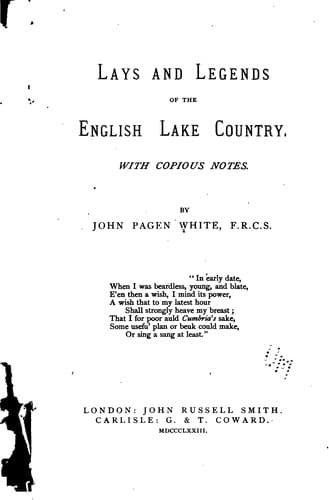
Lays and Legends of the English Lake Country: With Copious NotesWhite, John Pagen
General
Lays and Legends of the English Lake Country: With Copious Notes
White, John Pagen
Lake District (England) -- Poetry; Legends -- England -- Lake District
Lady Derwentwater, who had been unceasing in her efforts to save
her husband, and solaced him in his confinement by her society
and tender care, after his death succeeded eventually in having
his last request in the Tower fulfilled. She had his body borne
to its last resting place in the peaceful chapel at Dilston to be
interred with his ancestors. She made a short sojourn at Dilston
before leaving it for ever; and then repaired with her little son
and daughter to Canford, under the roof of her parents.
Before leaving the North, the Countess visited the house and
estates at Derwentwater; and while there her life seems to have
been in some danger; for the rude peasantry of the neighbourhood,
to whom her southern birth and foreign education, as well as the
principles and attachments in which she was brought up, were
doubtless uncongenial, blamed her, in the unreasoning vehemence
of their grief, for the tragic fate of their beloved lord and
benefactor. Accordingly, not far from the fall of Lodore, a hollow
in the wild heights of Walla Crag is pointed out by the name of
Lady's Rake,[5] in which the noble widow is said to have escaped
from their vengeance. Her misfortunes needed not to be thus
undeservedly augmented. A more pleasing version of the story of her
flight is, that the Countess escaped through the Lady's Rake with
the family jewels, when the officers of the crown took possession
of the mansion on Lord's Island. No doubt this loving woman did her
utmost for the release of her lord. And this steep and dangerous
way has a human interest associated with it which has given a
special hold upon the hearts of the Keswick people. In old times
a large white stone in among the boulders used to be pointed out
as the Lady's Pockethandkerchief, and that it still hung among the
crags, where no one could get at it.
In June, 1716, the Countess was living at Kensington Gravel Pits,
near London: whence she soon afterwards went to Hatherhope; and
subsequently made a brief sojourn under the roof of her parents at
Canford Manor; after which she took up her residence at Louvaine.
Here she died on the 30th of August, 1723, at the early age of
thirty; having survived her noble husband little more than seven
years; and was interred there in the Church of the English regular
Canonesses of St. Augustine.
The white or gray horse of the Earl is historical. Shortly before
the rising, and when he was in danger of apprehension, the
following short note was written by him:--
"Dilston, July 27th, 1715.
"Mr. Hunter,
Public-domain text, read in full here on John Shaqi.
Reviews
Reviews
No reviews yet
Be the first to share your thoughts on this work.
Elsewhere in the archive
Join the Discussion
Join the discussion
Sign in to leave a comment or review.
Sign InorCreate an account