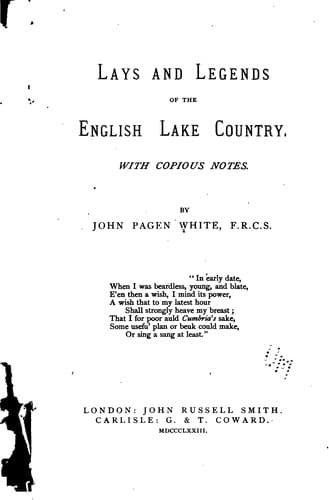
Lays and Legends of the English Lake Country: With Copious NotesWhite, John Pagen
General
Lays and Legends of the English Lake Country: With Copious Notes
White, John Pagen
Lake District (England) -- Poetry; Legends -- England -- Lake District
The youths of a neighbourhood, rich and poor, were all educated
together; a circumstance which diffused and kept alive a plain
familiarity of intercourse among all ranks of people, which
inspired the lowest with independence of sentiment, and infused
no insolent or unreal consequence into the wealthy. Thus it was
no unusual thing for the yeoman and the shepherd to enliven their
employments or festivities with recitations from the bucolics of
Virgil, the idyls of Theocrites, or the wars of Troy. A story is
told of the late Mr. John Gunson, a worthy miller, who formerly
kept the Plough Inn, a small public-house near the Church at Ulpha.
Two or three young fellows from a neighbouring town, or, as some
say, a party of students from St. Bees School, being out on a
holiday excursion, called at John's, and after regaling themselves
with his ale, and indulging in a good deal of quizzing and banter
at the landlord's expense, demanded their bill. John in his homely
country dialect, said, "Nay, we niver mak' any bills here, ye hev
so much to pay"--mentioning the sum. "O," replied one of the wags,
"you cannot write: that is the cause of your excuse." John, who had
quietly suffered them to proceed in their remarks, retired, and
in a short time brought them in a bill written out in the Hebrew
language, which it need scarcely be said quite puzzled them. He
then sent them one in Greek, and afterwards in Latin, neither of
which they could make out. They then begged that he would tell
them in plain English what they had to pay. John laughed heartily
at their ignorance, which on this occasion shone as conspicuous as
their impertinence to their learned and unassuming host.
If such was the level upon which the yeomanry stood in an
educational sense, their favourite plan of bringing up their
younger sons to the learned professions, and especially the pulpit,
may account for a saying which is almost proverbial in Cumberland,
"Owt 'll mak' a parson!" meaning thereby that if one of their
sons proved more stupid than another, the church was the proper
destination for him.
In the more secluded valleys the scholars were taught in the
church; the curate, who was also schoolmaster, sitting within the
communion rails, and using the table as a desk, while the children
occupied the pews or the open space beside him.
In the parish register of the last named chapelry is a notice, that
a youth who had quitted the valley, and died in one of the towns
on the coast of Cumberland, had requested that his body should be
brought and interred at the foot of the pillar by which he had been
accustomed to sit while a school-boy.
Public-domain text, read in full here on John Shaqi.
Reviews
Reviews
No reviews yet
Be the first to share your thoughts on this work.
Elsewhere in the archive
Join the Discussion
Join the discussion
Sign in to leave a comment or review.
Sign InorCreate an account