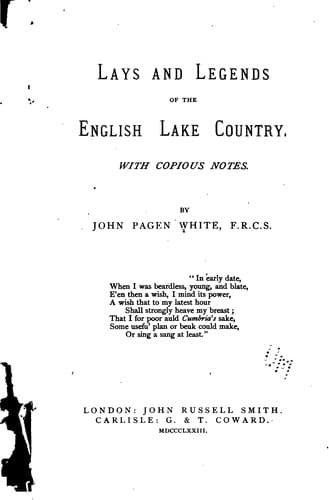
Lays and Legends of the English Lake Country: With Copious NotesWhite, John Pagen
General
Lays and Legends of the English Lake Country: With Copious Notes
White, John Pagen
Lake District (England) -- Poetry; Legends -- England -- Lake District
Teachers of writing and arithmetic also wandered from village to
village, being remunerated by a whittle gate. The churches and
chapels have mostly a little school-house adjoining. In some places
the school-house was a sort of antichapel to the place of worship,
being under the same roof, an arrangement which was abandoned as
irreverent. It continues however to this day in Borrowdale and some
other chapelries.
Superstitious fears were sometimes entertained lest a boy should
_learn too far_. It was usual to consider all schoolmasters as
_wise men_ or conjurors. Wise men were such as had spent their
lives in the pursuit of science, and had _learned too much_.
For conjuration was supposed to be a science which as naturally
followed other parts of learning as compound addition followed
simple addition. The wise man possessed wonderful power. He could
recover stolen goods, either by fetching back the articles,
showing the thief in a black mirror, or making him walk round the
cross on a market day, with the stolen goods on his shoulders.
The last, however, he could not do, if the culprit wore a piece
of _green sod_ upon his head. When any person applied to the
wise man for information, it was necessary for him to reach home
before midnight, as a storm was the certain consequence of the
application, and the applicant ran great risk of being tormented
by the devil all the way home. The wise men were supposed to have
made a compact with the devil, that he was to serve them for a
certain number of years, and then have them, body and soul, after
death. They were compelled to give the devil some living animal
whenever he called upon them, as a pledge that they intended to
give themselves at last. Instances are recorded of boys, in the
master's absence, having got to his books, and raised the devil.
The difficulty was to lay him again. He must be kept employed,
or have one of the boys for the trouble given to him. The broken
flag through which he rose is no doubt shown to this day. Such
superstitions are not so completely exploded in the country, but
that many equally improbable tales are told and believed.
The old register-book of the parish of Penrith, which appears to
have been commenced about the year 1599, contains some entries
of an earlier date, which have been either copied from a former
register, or inserted from memory. The following entries occur:--
"Liber Registerii de Penrith scriptus in anno dni 1599 anno regni
regine Elizabethe 41.
Proper nots worth keeping as followethe.
Floden feild was in anno dni 15....
Comotion in these north parts 1536.
St. George day dyd fall on good friday.
Queene Elizabethe begene her rainge 1558.
Plague was in Penrith and Kendal 1554.
Sollome Mose was in the yere....
Public-domain text, read in full here on John Shaqi.
Reviews
Reviews
No reviews yet
Be the first to share your thoughts on this work.
Elsewhere in the archive
Join the Discussion
Join the discussion
Sign in to leave a comment or review.
Sign InorCreate an account