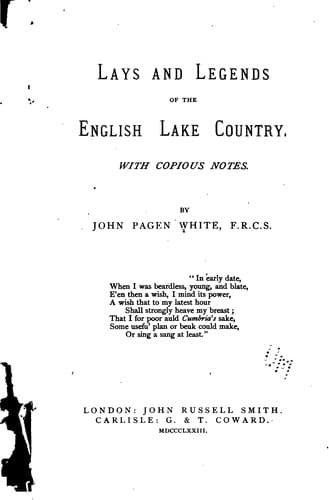
Lays and Legends of the English Lake Country: With Copious NotesWhite, John Pagen
General
Lays and Legends of the English Lake Country: With Copious Notes
White, John Pagen
Lake District (England) -- Poetry; Legends -- England -- Lake District
The name of the goblet was taken from the prophecy. There is
no writing to shew how it came into the family, nor any record
concerning it. Its history rests solely on the tradition. Dr.
Todd supposes it to have been a chalice, when it was unsafe to
have those sacred vessels made of costlier metals, on account
of the predatory habits which prevailed on the borders. He also
says, that the bishops of this diocese permitted not only the
parochial or secular, but also the monastic or regular clergy, to
celebrate the eucharist in chalices of that clear and transparent
metal. The following was one of the canons made in the reign of
king Athelstan:--_Sacer calix fusilis sit, non ligneus_--_Let the
holy chalice be fusile, and not of wood, which might imbibe the
consecrated wine._
William of Newbridge relates how one of these drinking-vessels,
called elfin goblets, came into the possession of King Henry
the First. A country-man belonging to a village near his own
birthplace, returning home late at night, and tipsy, from a visit
to a friend in a neighbouring village, heard a sound of merriment
and singing within a hill; and peeping through an open door in the
side of the hill, he saw a numerous company of both sexes feasting
in a large and finely lighted hall. A cup being handed to him by
one of the attendants, he took it, threw out the contents, and made
off with his booty, pursued by the whole party of revellers, from
whom he escaped by the speed of his mare, and reached his home in
safety. The cup, which was of unknown material and of unusual form
and colour was presented to the king.
At Muncaster Castle there is preserved an ancient glass vessel
of the basin form, about seven inches in diameter, ornamented
with some white enamelled mouldings; which, according to family
tradition, was presented by King Henry VI. to Sir John Pennington,
Knight, who was steadily attached to that unfortunate monarch, and
whom he had the honour of entertaining at Muncaster Castle, in
his flight from the Yorkists. In acknowledgment of the protection
he had received, the King is said to have presented his host with
this curious glass cup with a prayer that the family should ever
prosper, and never want a male heir, so long as they preserved it
unbroken: hence the cup was called "the luck of Muncaster." The
Hall contains, among other family pictures, one representing "King
Henry VI. giving to Sir John Pennington, on his leaving the Castle
1461, the luck of Muncaster."
Public-domain text, read in full here on John Shaqi.
Reviews
Reviews
No reviews yet
Be the first to share your thoughts on this work.
Elsewhere in the archive
Join the Discussion
Join the discussion
Sign in to leave a comment or review.
Sign InorCreate an account