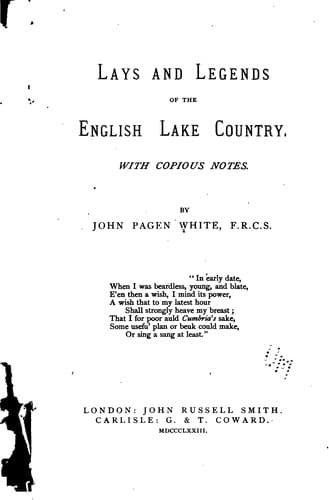
Lays and Legends of the English Lake Country: With Copious NotesWhite, John Pagen
General
Lays and Legends of the English Lake Country: With Copious Notes
White, John Pagen
Lake District (England) -- Poetry; Legends -- England -- Lake District
It is probable that the king was here on two occasions; the first
being after the battle of Towton, in 1461, when accompanied by his
queen and their young son, with the dukes of Exeter and Somerset,
he fled with great precipitation into Scotland: the second, after
the battle of Hexham, which was fought on the 15th of May, 1463. On
his defeat at Hexham, some friends of the fugitive king took him
under their protection, and conveyed him into Lancashire. During
the period that he remained in concealment, which was about twelve
months, the king visited Muncaster. On this occasion the royal
visit appears to have been attended with very little of regal pomp
or ceremony. Henry, having made his way into Cumberland, with only
one companion arrived at Irton Hall soon after midnight; but his
quality being unknown, or the inmates afraid to receive him, he
was denied admittance. He then passed over the mountains towards
Muncaster, where he was accidentally met by some shepherds at three
o'clock in the morning, and was conducted by them to Muncaster
Castle. The spot where the meeting took place is still indicated by
a tall steeple-like monument on an eminence at some distance from
the castle.
The "luck of Burrell Green," at the house of Mr. Lamb, yeoman,
in Great Salkeld, Cumberland, is less fragile in structure, is
not less venerated for its traditional alliance with the fortunes
of its possessors than the lordly cups of the Penningtons and
Musgraves. It is an _ancient_ brass dish resembling a shield, with
an inscription round it, now nearly effaced. Like the celebrated
glass of Edenhall, this too has its legend and couplet, the latter
of which runs thus:--
"If this dish be sold or gi'en,
Farewell the luck of Burrell Green."
When Ranulph de Meschines had received the grant of Cumberland from
William the Conqueror, he made a survey of the whole county, and
gave to his followers all the frontiers bordering on Scotland and
Northumberland, retaining to himself the central part between the
east and west mountains, "a goodly great forest, full of woods,
red deer and fallow, wild swine, and all manner of wild beasts."
This Forest of Inglewood comprehends all that large and now fertile
tract of country, extending westward from Carlisle to Westward,
thence in a direct line through Castle Sowerby and Penrith to the
confluence of the Eamont and the Eden, which latter river then
forms its eastern boundary all the way northward to Carlisle,
forming a sort of triangle, each side of which is more than twenty
miles in length. The Duke of Devonshire, as lord of the Honour of
Penrith, has now paramount authority over the manors of Inglewood
Forest.
Public-domain text, read in full here on John Shaqi.
Reviews
Reviews
No reviews yet
Be the first to share your thoughts on this work.
Elsewhere in the archive
Join the Discussion
Join the discussion
Sign in to leave a comment or review.
Sign InorCreate an account