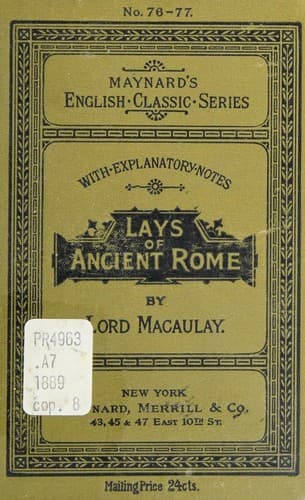
Lays of Ancient RomeMacaulay, Thomas Babington Macaulay, Baron
History
Lays of Ancient Rome
Macaulay, Thomas Babington Macaulay, Baron
Rome -- History -- Poetry
Produced by David Reed and David Widger
LAYS OF ANCIENT ROME
By Thomas Babington Macaulay
Contents:
Preface
Horatius
The Lay
The Battle of the Lake Regillus
The Lay
Virginia
The Lay
The Prophecy of Capys
The Lay
That what is called the history of the Kings and early Consuls of
Rome is to a great extent fabulous, few scholars have, since the
time of Beaufort, ventured to deny. It is certain that, more than
three hundred and sixty years after the date ordinarily assigned
for the foundation of the city, the public records were, with
scarcely an exception, destroyed by the Gauls. It is certain that
the oldest annals of the commonwealth were compiled more than a
century and a half after this destruction of the records. It is
certain, therefore, that the great Latin writers of the Augustan
age did not possess those materials, without which a trustworthy
account of the infancy of the republic could not possibly be
framed. Those writers own, indeed, that the chronicles to which
they had access were filled with battles that were never fought,
and Consuls that were never inaugurated; and we have abundant
proof that, in these chronicles, events of the greatest
importance, such as the issue of the war with Porsena and the
issue of the war with Brennus, were grossly misrepresented. Under
these circumstances a wise man will look with great suspicion on
the legend which has come down to us. He will perhaps be inclined
to regard the princes who are said to have founded the civil and
religious institutions of Rome, the sons of Mars, and the husband
of Egeria, as mere mythological personages, of the same class
with Perseus and Ixion. As he draws nearer to the confines of
authentic history, he will become less and less hard of belief.
He will admit that the most important parts of the narrative have
some foundation in truth. But he will distrust almost all the
details, not only because they seldom rest on any solid evidence,
but also because he will constantly detect in them, even when
they are within the limits of physical possibility, that peculiar
character, more easily understood than defined, which
distinguishes the creations of the imagination from the realities
of the world in which we live.
Public-domain text, read in full here on John Shaqi.
Reviews
Reviews
No reviews yet
Be the first to share your thoughts on this work.
Join the Discussion
Join the discussion
Sign in to leave a comment or review.
Sign InorCreate an account