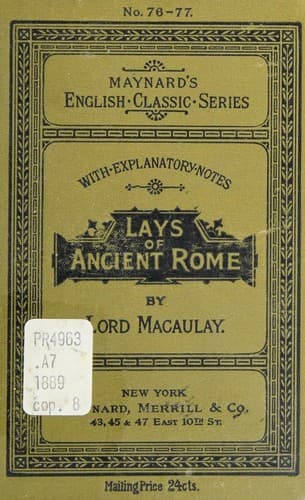
Lays of Ancient RomeMacaulay, Thomas Babington Macaulay, Baron
History
Lays of Ancient Rome
Macaulay, Thomas Babington Macaulay, Baron
Rome -- History -- Poetry
It may be worth while to select a particular story, and to trace
its probable progress through these stages. The description of
the migration of the Fabian house to Cremera is one of the finest
of the many fine passages which lie thick in the earlier books of
Livy. The Consul, clad in his military garb, stands in the
vestibule of his house, marshalling his clan, three hundred and
six fighting men, all of the same proud patrician blood, all
worthy to be attended by the fasces, and to command the legions.
A sad and anxious retinue of friends accompanies the adventurers
through the streets; but the voice of lamentation is drowned by
the shouts of admiring thousands. As the procession passes the
Capitol, prayers and vows are poured forth, but in vain. The
devoted band, leaving Janus on the right, marches to its doom,
through the Gate of Evil Luck. After achieving high deeds of
valor against overwhelming numbers, all perish save one child,
the stock from which the great Fabian race was destined again to
spring, for the safety and glory of the commonwealth. That this
fine romance, the details of which are so full of poetical truth,
and so utterly destitute of all show of historical truth, came
originally from some lay which had often been sung with great
applause at banquets is in the highest degree probable. Nor is it
difficult to imagine a mode in which the transmission might have
taken place. The celebrated Quintus Fabius Maximus, who died
about twenty years before the First Punic War, and more than
forty years before Ennius was born, is said to have been interred
with extraordinary pomp. In the eulogy pronounced over his body
all the great exploits of his ancestors were doubtless recounted
and exaggerated. If there were then extant songs which gave a
vivid and touching description of an event, the saddest and the
most glorious in the long history of the Fabian house, nothing
could be more natural than that the panegyrist should borrow from
such songs their finest touches, in order to adorn his speech. A
few generations later the songs would perhaps be forgotten, or
remembered only by shepherds and vinedressers. But the speech
would certainly be preserved in the archives of the Fabian
nobles. Fabius Pictor would be well acquainted with a document so
interesting to his personal feelings, and would insert large
extracts from it in his rude chronicle. That chronicle, as we
know, was the oldest to which Livy had access. Livy would at a
glance distinguish the bold strokes of the forgotten poet from
the dull and feeble narrative by which they were surrounded,
would retouch them with a delicate and powerful pencil, and would
make them immortal.
Public-domain text, read in full here on John Shaqi.
Reviews
Reviews
No reviews yet
Be the first to share your thoughts on this work.
Join the Discussion
Join the discussion
Sign in to leave a comment or review.
Sign InorCreate an account