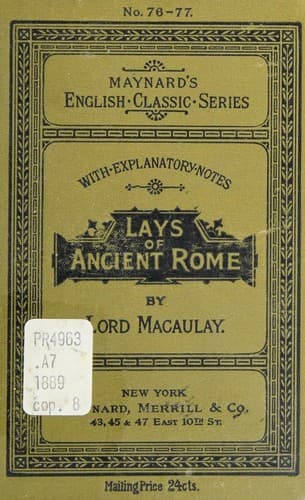
Lays of Ancient RomeMacaulay, Thomas Babington Macaulay, Baron
History
Lays of Ancient Rome
Macaulay, Thomas Babington Macaulay, Baron
Rome -- History -- Poetry
In the following poems the author speaks, not in his own person,
but in the persons of ancient minstrels who know only what Roman
citizen, born three or four hundred years before the Christian
era, may be supposed to have known, and who are in no wise above
the passions and prejudices of their age and nation. To these
imaginary poets must be ascribed some blunders which are so
obvious that is unnecessary to point them out. The real blunder
would have been to represent these old poets as deeply versed in
general history, and studious of chronological accuracy. To them
must also be attributed the illiberal sneers at the Greeks, the
furious party spirit, the contempt for the arts of peace, the
love of war for its own sake, the ungenerous exultation over the
vanquished, which the reader will sometimes observe. To portray a
Roman of the age of Camillus or Curius as superior to national
antipathies, as mourning over the devastation and slaughter by
which empire and triumphs were to be won, as looking on human
suffering with the sympathy of Howard, or as treating conquered
enemies with the delicacy of the Black Prince, would be to
violate all dramatic propriety. The old Romans had some great
virtues, fortitude, temperance, veracity, spirit to resist
oppression, respect for legitimate authority, fidelity in the
observing of contracts, disinterestedness, ardent patriotism; but
Christian charity and chivalrous generosity were alike unknown to
them.
It would have been obviously improper to mimic the manner of any
particular age or country. Something has been borrowed, however,
from our own old ballads, and more from Sir Walter Scott, the
great restorer of our ballad-poetry. To the Iliad still greater
obligations are due; and those obligations have been contracted
with the less hesitation, because there is reason to believe that
some of the old Latin minstrels really had recourse to that
inexhaustible store of poetical images.
It would have been easy to swell this little volume to a very
considerable bulk, by appending notes filled with quotations; but
to a learned reader such notes are not necessary; for an
unlearned reader they would have little interest; and the
judgment passed both by the learned and by the unlearned on a
work of the imagination will always depend much more on the
general character and spirit of such a work than on minute
details.
Horatius
Public-domain text, read in full here on John Shaqi.
Reviews
Reviews
No reviews yet
Be the first to share your thoughts on this work.
Join the Discussion
Join the discussion
Sign in to leave a comment or review.
Sign InorCreate an account