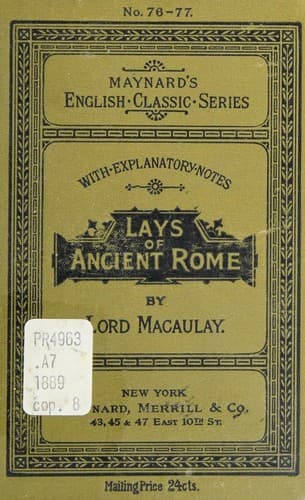
Lays of Ancient RomeMacaulay, Thomas Babington Macaulay, Baron
History
Lays of Ancient Rome
Macaulay, Thomas Babington Macaulay, Baron
Rome -- History -- Poetry
And nearer fast and nearer
Doth the red whirlwind come;
And louder still and still more loud,
From underneath that rolling cloud,
Is heard the trumpet's war-note proud,
The trampling, and the hum.
And plainly and more plainly
Now through the gloom appears,
Far to left and far to right,
In broken gleams of dark-blue light,
The long array of helmets bright,
The long array of spears.
XXII
And plainly and more plainly,
Above that glimmering line,
Now might ye see the banners
Of twelve fair cities shine;
But the banner of proud Clusium
Was highest of them all,
The terror of the Umbrian,
The terror of the Gaul.
XXIII
And plainly and more plainly
Now might the burghers know,
By port and vest, by horse and crest,
Each warlike Lucumo.
There Cilnius of Arretium
On his fleet roan was seen;
And Astur of the four-fold shield,
Girt with the brand none else may wield,
Tolumnius with the belt of gold,
And dark Verbenna from the hold
By reedy Thrasymene.
XXIV
Fast by the royal standard,
O'erlooking all the war,
Lars Porsena of Clusium
Sat in his ivory car.
By the right wheel rode Mamilius,
Prince of the Latian name;
And by the left false Sextus,
That wrought the deed of shame.
XXV
But when the face of Sextus
Was seen among the foes,
A yell that rent the firmament
From all the town arose.
On the house-tops was no woman
But spat towards him and hissed,
No child but screamed out curses,
And shook its little fist.
XXVI
But the Consul's brow was sad,
And the Consul's speech was low,
And darkly looked he at the wall,
And darkly at the foe.
"Their van will be upon us
Before the bridge goes down;
And if they once may win the bridge,
What hope to save the town?"
XXVII
Then out spake brave Horatius,
The Captain of the Gate:
"To every man upon this earth
Death cometh soon or late.
And how can man die better
Than facing fearful odds,
For the ashes of his fathers,
And the temples of his gods,
XXVIII
"And for the tender mother
Who dandled him to rest,
And for the wife who nurses
His baby at her breast,
And for the holy maidens
Who feed the eternal flame,
To save them from false Sextus
That wrought the deed of shame?
XXIX
Public-domain text, read in full here on John Shaqi.
Reviews
Reviews
No reviews yet
Be the first to share your thoughts on this work.
Join the Discussion
Join the discussion
Sign in to leave a comment or review.
Sign InorCreate an account