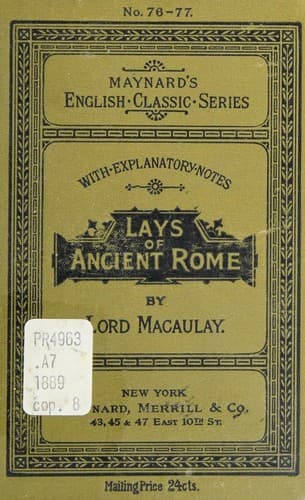
Lays of Ancient RomeMacaulay, Thomas Babington Macaulay, Baron
History
Lays of Ancient Rome
Macaulay, Thomas Babington Macaulay, Baron
Rome -- History -- Poetry
Lake Regillus is in all respects a Homeric battle, except that
the combatants ride astride on their horses, instead of driving
chariots. The mass of fighting men is hardly mentioned. The
leaders single each other out, and engage hand to hand. The great
object of the warriors on both sides is, as in the Iliad, to
obtain possession of the spoils and bodies of the slain; and
several circumstances are related which forcibly remind us of the
great slaughter round the corpses of Sarpedon and Patroclus.
But there is one circumstance which deserves especial notice.
Both the war of Troy and the war of Regillus were caused by the
licentious passions of young princes, who were therefore
peculiarly bound not to be sparing of their own persons on the
day of battle. Now the conduct of Sextus at Regillus, as
described by Livy, so exactly resembles that of Paris, as
described at the beginning of the third book of the Iliad, that
it is difficult to believe the resemblance accidental. Paris
appears before the Trojan ranks, defying the bravest Greek to
encounter him:--
3 lines from the Iliad, in Greek, probably those
translated by Pope as:
...to the van, before the sons of fame
Whom Troy sent forth, the beauteous Paris came:
Livy introduces Sextus in a similar manner: "Ferocem juvenem
Tarquinium, ostentantem se in prima exsulum acie." Menelaus
rushes to meet Paris. A Roman noble, eager for vengeance, spurs
his horse towards Sextus. Both the guilty princes are instantly
terror-stricken:--
3 more lines in Greek, Pope's translation being:
...[Menelaus] approaching near,
The beauteous champion views with marks of fear,
Smit with a conscious sense, retires behind,
And shuns the fate he well deserv'd to find.
"Tarquinius," says Livy, "retro in agmen suorum infenso cessit
hosti." If this be a fortuitous coincidence, it is also one of
the most extraordinary in literature.
In the following poem, therefore, images and incidents have been
borrowed, not merely without scruple, but on principle, from the
incomparable battle-pieces of Homer.
Public-domain text, read in full here on John Shaqi.
Reviews
Reviews
No reviews yet
Be the first to share your thoughts on this work.
Join the Discussion
Join the discussion
Sign in to leave a comment or review.
Sign InorCreate an account