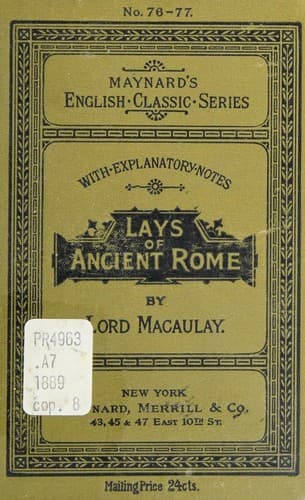
Lays of Ancient RomeMacaulay, Thomas Babington Macaulay, Baron
History
Lays of Ancient Rome
Macaulay, Thomas Babington Macaulay, Baron
Rome -- History -- Poetry
generation which had fought at Regillus had passed away. Nor
could anything be more natural than that the poets of the next
age should embellish this story, and make the celestial horsemen
bear the tidings of victory to Rome.
Many years after the temple of the Twin Gods had been built in
the Forum, an important addition was made to the ceremonial by
which the state annually testified its gratitude for their
protection. Quintus Fabius and Publius Decius were elected
Censors at a momentous crisis. It had become absolutely necessary
that the classification of the citizens should be revised. On
that classification depended the distribution of political power.
Party spirit ran high; and the republic seemed to be in danger of
falling under the dominion either of a narrow oligarchy or of an
ignorant and headstrong rabble. Under such circumstances, the
most illustrious patrician and the most illustrious plebeian of
the age were entrusted with the office of arbitrating between the
angry factions; and they performed their arduous task to the
satisfaction of all honest and reasonable men.
One of their reforms was the remodelling of the equestrian order;
and, having effected this reform, they determined to give to
their work a sanction derived from religion. In the chivalrous
societies of modern times,--societies which have much more than
may at first sight appear in common with with the equestrian
order of Rome,--it has been usual to invoke the special
protection of some Saint, and to observe his day with peculiar
solemnity. Thus the Companions of the Garter wear the image of
St. George depending from their collars, and meet, on great
occasions, in St. George's Chapel. Thus, when Louis the
Fourteenth instituted a new order of chivalry for the rewarding
of military merit, he commended it to the favor of his own
glorified ancestor and patron, and decreed that all the members
of the fraternity should meet at the royal palace on the feast of
St. Louis, should attend the king to chapel, should hear mass,
and should subsequently hold their great annual assembly. There
is a considerable resemblance between this rule of the order of
St. Louis and the rule which Fabius and Decius made respecting
the Roman knights. It was ordained that a grand muster and
inspection of the equestrian body should be part of the
ceremonial performed, on the anniversary of the battle of
Regillus, in honor of Castor and Pollux, the two equestrian gods.
All the knights, clad in purple and crowned with olive, were to
meet at a temple of Mars in the suburbs. Thence they were to ride
in state to the Forum, where the temple of the Twins stood. This
pageant was, during several centuries, considered as one of the
most splendid sights of Rome. In the time of Dionysius the
cavalcade sometimes consisted of five thousand horsemen, all
persons of fair repute and easy fortune.
Public-domain text, read in full here on John Shaqi.
Reviews
Reviews
No reviews yet
Be the first to share your thoughts on this work.
Join the Discussion
Join the discussion
Sign in to leave a comment or review.
Sign InorCreate an account