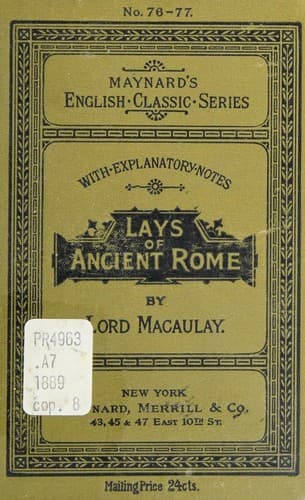
Lays of Ancient RomeMacaulay, Thomas Babington Macaulay, Baron
History
Lays of Ancient Rome
Macaulay, Thomas Babington Macaulay, Baron
Rome -- History -- Poetry
Even in the age of Plutarch there were discerning men who
rejected the popular account of the foundation of Rome, because
that account appeared to them to have the air, not of a history,
but of a romance or a drama. Plutarch, who was displeased at
their incredulity, had nothing better to say in reply to their
arguments than that chance sometimes turns poet, and produces
trains of events not to be distinguished from the most elaborate
plots which are constructed by art. But though the existence of a
poetical element in the early history of the Great City was
detected so many ages ago, the first critic who distinctly saw
from what source that poetical element had been derived was James
Perizonius, one of the most acute and learned antiquaries of the
seventeenth century. His theory, which in his own days attracted
little or no notice, was revived in the present generation by
Niebuhr, a man who would have been the first writer of his time,
if his talent for communicating truths had borne any proportion
to his talent for investigating them. That theory has been
adopted by several eminent scholars of our own country,
particularly by the Bishop of St. David's, by Professor Malde,
and by the lamented Arnold. It appears to be now generally
received by men conversant with classical antiquity; and indeed
it rests on such strong proofs, both internal and external, that
it will not be easily subverted. A popular exposition of this
theory, and of the evidence by which it is supported, may not be
without interest even for readers who are unacquainted with the
ancient languages.
The Latin literature which has come down to us is of later date
than the commencement of the Second Punic War, and consists
almost exclusively of works fashioned on Greek models. The Latin
metres, heroic, elegiac, lyric, and dramatic, are of Greek
origin. The best Latin epic poetry is the feeble echo of the
Iliad and Odyssey. The best Latin eclogues are imitations of
Theocritus. The plan of the most finished didactic poem in the
Latin tongue was taken from Hesiod. The Latin tragedies are bad
copies of the masterpieces of Sophocles and Euripides. The Latin
philosophy was borrowed, without alteration, from the Portico and
the Academy; and the great Latin orators constantly proposed to
themselves as patterns the speeches of Demosthenes and Lysias.
Public-domain text, read in full here on John Shaqi.
Reviews
Reviews
No reviews yet
Be the first to share your thoughts on this work.
Join the Discussion
Join the discussion
Sign in to leave a comment or review.
Sign InorCreate an account