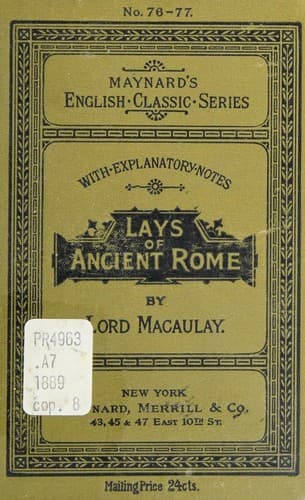
Lays of Ancient RomeMacaulay, Thomas Babington Macaulay, Baron
History
Lays of Ancient Rome
Macaulay, Thomas Babington Macaulay, Baron
Rome -- History -- Poetry
And all the people trembled,
And pale grew every cheek;
And Sergius the High Pontiff
Alone found voice to speak:
"The gods who live forever
Have fought for Rome to-day!
These be the Great Twin Brethren
To whom the Dorians pray.
Back comes the chief in triumph,
Who, in the hour of fight,
Hath seen the Great Twin Brethren
In harness on his right.
Safe comes the ship to haven,
Through billows and through gales,
If once the Great Twin Brethren
Sit shining on the sails.
Wherefore they washed their horses
In Vesta's holy well,
Wherefore they rode to Vesta's door,
I know, but may not tell.
Here, hard by Vesta's temple,
Build we a stately dome
Unto the Great Twin Brethren
Who fought so well for Rome.
And when the months returning
Bring back this day of fight,
The proud Ides of Quintilis,
Marked evermore with white,
Unto the Great Twin Brethren
Let all the people throng,
With chaplets and with offerings,
With music and with song;
And let the doors and windows
Be hung with garlands all,
And let the knights be summoned
To Mars without the wall:
Thence let them ride in purple
With joyous trumpet-sound,
Each mounted on his war-horse,
And each with olive crowned;
And pass in solemn order
Before the sacred dome,
Where dwell the Great Twin Brethren
Who fought so well for Rome."
Virginia
A collection consisting exclusively of war-songs would give an
imperfect, or rather an erroneous, notion of the spirit of the
old Latin ballads. The Patricians, during more than a century
after the expulsion of the Kings, held all the high military
commands. A Plebeian, even though, like Lucius Siccius, he were
distinguished by his valor and knowledge of war, could serve only
in subordinate posts. A minstrel, therefore, who wished to
celebrate the early triumphs of his country, could hardly take
any but Patricians for his heroes. The warriors who are mentioned
in the two preceding lays, Horatius, Lartius, Herminius, Aulus
Posthumius, Æbutius Elva, Sempronius Atratinus, Valerius
Poplicola, were all members of the dominant order; and a poet who
was singing their praises, whatever his own political opinions
might be, would naturally abstain from insulting the class to
which they belonged, and from reflecting on the system which had
placed such men at the head of the legions of the Commonwealth.
Public-domain text, read in full here on John Shaqi.
Reviews
Reviews
No reviews yet
Be the first to share your thoughts on this work.
Join the Discussion
Join the discussion
Sign in to leave a comment or review.
Sign InorCreate an account