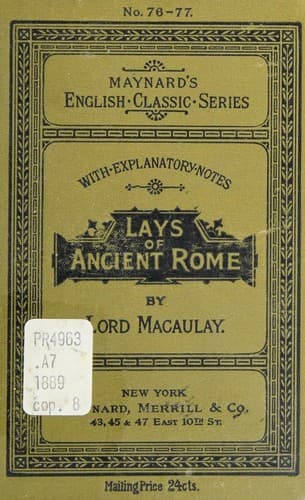
Lays of Ancient RomeMacaulay, Thomas Babington Macaulay, Baron
History
Lays of Ancient Rome
Macaulay, Thomas Babington Macaulay, Baron
Rome -- History -- Poetry
The fame of Greece in arms, as well as in arts, was then at the
height. Half a century earlier, the career of Alexander had
excited the admiration and terror of all nations from the Ganges
to the Pillars of Hercules. Royal houses, founded by Macedonian
captains, still reigned at Antioch and Alexandria. That barbarian
warriors, led by barbarian chiefs, should win a pitched battle
against Greek valor guided by Greek science, seemed as incredible
as it would now seem that the Burmese or the Siamese should, in
the open plain, put to flight an equal number of the best English
troops. The Tarentines were convinced that their countrymen were
irresistible in war; and this conviction had emboldened them to
treat with the grossest indignity one whom they regarded as the
representative of an inferior race. Of the Greek generals then
living Pyrrhus was indisputably the first. Among the troops who
were trained in the Greek discipline his Epirotes ranked high.
His expedition to Italy was a turning-point in the history of the
world. He found there a people who, far inferior to the Athenians
and Corinthians in the fine arts, in the speculative sciences,
and in all the refinements of life, were the best soldiers on the
face of the earth. Their arms, their gradations of rank, their
order of battle, their method of intrenchment, were all of Latin
origin, and had all been gradually brought near to perfection,
not by the study of foreign models, but by the genius and
experience of many generations of great native commanders. The
first words which broke from the king, when his practised eye had
surveyed the Roman encampment, were full of meaning: "These
barbarians," he said, "have nothing barbarous in their military
arrangements." He was at first victorious; for his own talents
were superior to those of the captains who were opposed to him;
and the Romans were not prepared for the onset of the elephants
of the East, which were then for the first time seen in
Italy--moving mountains, with long snakes for hands. But the
victories of the Epirotes were fiercely disputed, dearly
purchased, and altogether unprofitable. At length, Manius Curius
Dentatus, who had in his first Consulship won two triumphs, was
again placed at the head of the Roman Commonwealth, and sent to
conquer the invaders. A great battle was fought near Beneventum.
Pyrrhus was completely defeated. He repassed the sea; and the
world learned, with amazement, that a people had been discovered
who, in fair fighting, were superior to the best troops that had
been drilled on the system of Parmenio and Antigonus.
Public-domain text, read in full here on John Shaqi.
Reviews
Reviews
No reviews yet
Be the first to share your thoughts on this work.
Elsewhere in the archive
Join the Discussion
Join the discussion
Sign in to leave a comment or review.
Sign InorCreate an account