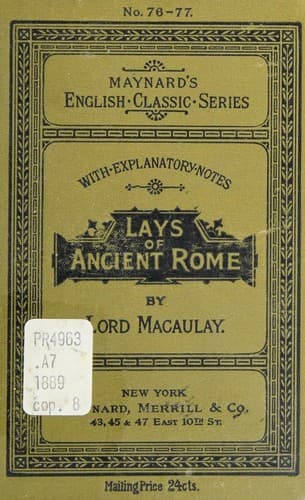
Lays of Ancient RomeMacaulay, Thomas Babington Macaulay, Baron
History
Lays of Ancient Rome
Macaulay, Thomas Babington Macaulay, Baron
Rome -- History -- Poetry
The conquerors had a good right to exult in their success; for
their glory was all their own. They had not learned from their
enemy how to conquer him. It was with their own national arms,
and in their own national battle array, that they had overcome
weapons and tactics long believed to be invincible. The pilum and
the broadsword had vanquished the Macedonian spear. The legion
had broken the Macedonian phalanx. Even the elephants, when the
surprise produced by their first appearance was over, could cause
no disorder in the steady yet flexible battalions of Rome.
It is said by Florus, and may easily be believed, that the
triumph far surpassed in magnificence any that Rome had
previously seen. The only spoils which Papirius Cursor and Fabius
Maximus could exhibit were flocks and herds, wagons of rude
structure, and heaps of spears and helmets. But now, for the
first time, the riches of Asia and the arts of Greece adorned a
Roman pageant. Plate, fine stuffs, costly furniture, rare
animals, exquisite paintings and sculptures, formed part of the
procession. At the banquet would be assembled a crowd of warriors
and statesmen, among whom Manius Curius Dentatus would take the
highest room. Caius Fabricius Luscinus, then, after two
Consulships and two triumphs, Censor of the Commonwealth, would
doubtless occupy a place of honor at the board. In situations
less conspicuous probably lay some of those who were, a few years
later, the terror of Carthage: Caius Duilius, the founder of the
maritime greatness of his country; Marcus Atilius Regulus, who
owed to defeat a renown far higher than that which he had derived
from his victories; and Caius Lutatius Catalus, who, while
suffering from a grievous wound, fought the great battle of the
Æates, and brought the First Punic War to a triumphant close. It
is impossible to recount the names of these eminent citizens,
without reflecting that they were, without exception, Plebeians,
and would, but for the ever memorable struggle maintained by
Caius Licinius and Lucius Sextius, have been doomed to hide in
obscurity, or to waste in civil broils, the capacity and energy
which prevailed against Pyrrhus and Hamilcar.
On such a day we may suppose that the patriotic enthusiasm of a
Latin poet would vent itself in reiterated shouts of "Io
triumphe," such as were uttered by Horace on a far less exciting
occasion, and in boasts resembling those which Virgil put into
the mouth of Anchises. The superiority of some foreign nations,
and especially of the Greeks, in the lazy arts of peace, would be
admitted with disdainful candor; but preëminence in all the
qualities which fit a people to subdue and govern mankind would
be claimed for the Romans.
Public-domain text, read in full here on John Shaqi.
Reviews
Reviews
No reviews yet
Be the first to share your thoughts on this work.
Elsewhere in the archive
Join the Discussion
Join the discussion
Sign in to leave a comment or review.
Sign InorCreate an account