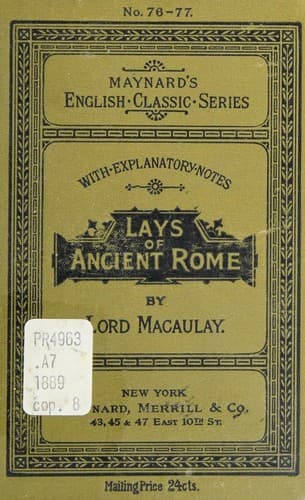
Lays of Ancient RomeMacaulay, Thomas Babington Macaulay, Baron
History
Lays of Ancient Rome
Macaulay, Thomas Babington Macaulay, Baron
Rome -- History -- Poetry
Varro, whose authority on all questions connected with the
antiquities of his country is entitled to the greatest respect,
tells us that at banquets it was once the fashion for boys to
sing, sometimes with and sometimes without instrumental music,
ancient ballads in praise of men of former times. These young
performers, he observes, were of unblemished character, a
circumstance which he probably mentioned because, among the
Greeks, and indeed, in his time among the Romans also, the morals
of singing boys were in no high repute.
The testimony of Horace, though given incidentally, confirms the
statements of Cato, Valerius Maximus, and Varro. The poet
predicts that, under the peaceful administration of Augustus, the
Romans will, over their full goblets, sing to the pipe, after the
fashion of their fathers, the deeds of brave captains, and the
ancient legends touching the origin of the city.
The proposition, then, that Rome had ballad-poetry is not merely
in itself highly probable, but is fully proved by direct evidence
of the greatest weight.
This proposition being established, it becomes easy to understand
why the early history of the city is unlike almost everything
else in Latin literature, native where almost everything else is
borrowed, imaginative where almost everything else is prosaic. We
can scarcely hesitate to pronounce that the magnificent,
pathetic, and truly national legends, which present so striking a
contrast to all that surrounds them, are broken and defaced
fragments of that early poetry which, even in the age of Cato the
Censor, had become antiquated, and of which Tully had never heard
a line.
Public-domain text, read in full here on John Shaqi.
Reviews
Reviews
No reviews yet
Be the first to share your thoughts on this work.
Join the Discussion
Join the discussion
Sign in to leave a comment or review.
Sign InorCreate an account