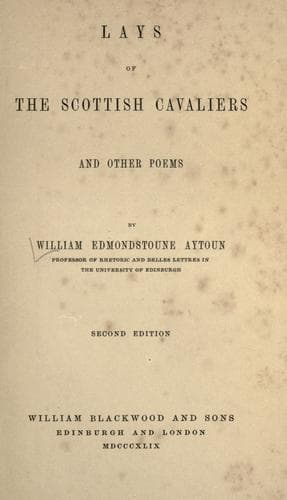
Lays of the Scottish Cavaliers and Other PoemsAytoun, William Edmondstoune
History
Lays of the Scottish Cavaliers and Other Poems
Aytoun, William Edmondstoune
Scotland -- History -- Poetry
Though the roar of conflagration
Bellow o'er the sinking town;
There is yet one place of shelter,
Where the foeman cannot come,
Where the summons never sounded
Of the trumpet or the drum.
There again we'll meet our children,
Who, on Flodden's trampled sod,
For their king and for their country
Rendered up their souls to God.
There shall we find rest and refuge,
With our dear departed brave;
And the ashes of the city
Be our universal grave!"
THE EXECUTION OF MONTROSE
The most poetical chronicler would find it impossible to render the
incidents of Montrose's brilliant career more picturesque than the
reality. Among the devoted champions who, during the wildest and most
stormy period of our history, maintained the cause of Church and King,
"the Great Marquis" undoubtedly is entitled to the foremost place. Even
party malevolence, by no means extinct at the present day, has been
unable to detract from the eulogy pronounced upon him by the famous
Cardinal de Retz, the friend of Condé and Turenne, when he thus summed
up his character:--"Montrose, a Scottish nobleman, head of the house of
Grahame--the only man in the world that has ever realised to me the
ideas of certain heroes, whom we now discover nowhere but in the lives
of Plutarch--has sustained in his own country the cause of the King his
master, with a greatness of soul that has not found its equal in our
age."
But the success of the victorious leader and patriot is almost thrown
into the shade by the noble magnanimity and Christian heroism of the man
in the hour of defeat and death. Without wishing, in any degree, to
revive a controversy long maintained by writers of opposite political
and polemical opinions, it may fairly be stated that Scottish history
does not present us with a tragedy of parallel interest. That the
execution of Montrose was the natural, nay, the inevitable, consequence
of his capture, may be freely admitted even by the fiercest partisan of
the cause for which he staked his life. In those times, neither party
was disposed to lenity; and Montrose was far too conspicuous a
character, and too dangerous a man, to be forgiven. But the ignominious
and savage treatment which he received at the hands of those whose
station and descent should at least have taught them to respect
misfortune, has left an indelible stain upon the memory of the
Covenanting chiefs, and more especially upon that of Argyle.
Public-domain text, read in full here on John Shaqi.
Reviews
Reviews
No reviews yet
Be the first to share your thoughts on this work.
Join the Discussion
Join the discussion
Sign in to leave a comment or review.
Sign InorCreate an account