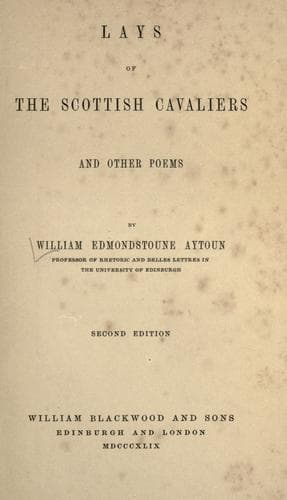
Lays of the Scottish Cavaliers and Other PoemsAytoun, William Edmondstoune
History
Lays of the Scottish Cavaliers and Other Poems
Aytoun, William Edmondstoune
Scotland -- History -- Poetry
"_Friday, 17th May_.--Act ordaining James Grahame to be brought from the
Watergate on a cart, bareheaded, the hangman in his livery, covered,
riding on the horse that draws the cart--the prisoner to be bound to the
cart with a rope--to the Tolbooth of Edinburgh, and from thence to be
brought to the Parliament House, and there, in the place of delinquents,
on his knees, to receive his sentence--viz., to be hanged on a gibbet at
the Cross of Edinburgh, with his book and declaration tied on a rope
about his neck, and there to hang for the space of three hours until he
be dead; and thereafter to be cut down by the hangman, his head, hands,
and legs to be cut off, and distributed as follows--viz., his head to be
affixed on an iron pin, and set on the pinnacle of the west gavel of the
new prison of Edinburgh; one hand to be set on the port of Perth, the
other on the port of Stirling; one leg and foot on the port of Aberdeen,
the other on the port of Glasgow. If at his death penitent, and relaxed
from excommunication, then the trunk of his body to be interred, by
pioneers, in the Greyfriars; otherwise, to be interred in the
Boroughmuir, by the hangman's men, under the gallows."--BALFOUR'S _Notes
of Parliament_.
It is needless to remark that this inhuman sentence was executed to the
letter. In order that the exposure might be more complete, the cart was
constructed with a high chair in the centre, having holes behind,
through which the ropes that fastened him were drawn. The author of the
_Wigton Papers_, recently published by the Maitland Club, says, "The
reason of his being tied to the cart was in hope that the people would
have stoned him, and that he might not be able by his hands to save his
face." His hat was then pulled off by the hangman and the procession
commenced.
"_But when he came, though pale and wan,
He looked so great and high_,"--p. 37.
"In all the way, there appeared in him such majesty, courage,
modesty--and even somewhat more than natural--that those common women
who had lost their husbands and children in his wars, and who were hired
to stone him, were upon the sight of him so astonished and moved, that
their intended curses turned into tears and prayers; so that next day
_all the ministers preached against them for not stoning and reviling
him."--Wigton Papers._
"_Then first a woman's voice was heard
In jeer and laughter loud_,"--p. 38.
"It is remarkable that, of the many thousand beholders, the Lady Jean
Gordon, Countess of Haddington, did (alone) publicly insult and laugh at
him; which being perceived by a gentleman in the street, he cried up to
her, that it became her better to sit upon the cart for her
adulteries."--_Wigton Papers_. This infamous woman was the third
daughter of Huntly, and the niece of Argyle. It will hardly be credited
that she was the sister of that gallant Lord Gordon, who fell fighting
by the side of Montrose, only five years before, at the battle of
Aldford!
Public-domain text, read in full here on John Shaqi.
Reviews
Reviews
No reviews yet
Be the first to share your thoughts on this work.
Join the Discussion
Join the discussion
Sign in to leave a comment or review.
Sign InorCreate an account