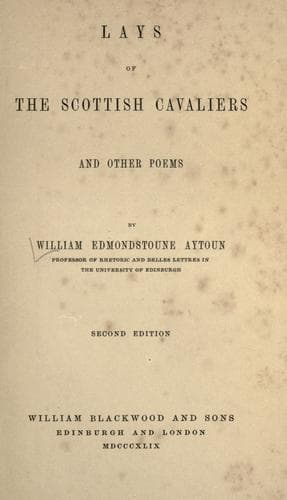
Lays of the Scottish Cavaliers and Other PoemsAytoun, William Edmondstoune
History
Lays of the Scottish Cavaliers and Other Poems
Aytoun, William Edmondstoune
Scotland -- History -- Poetry
Those who have visited that romantic spot need not be reminded of its
peculiar features, for these, once seen, must dwell for ever in the
memory. The lower part of the Pass is a stupendous mountain-chasm,
scooped out by the waters of the Garry, which here descend in a
succession of roaring cataracts and pools. The old road, which ran
almost parallel to the river and close upon its edge, was extremely
narrow, and wound its way beneath a wall of enormous crags, surmounted
by a natural forest of birch, oak, and pine. An army cooped up in that
gloomy ravine would have as little chance of escape from the onset of an
enterprising partisan corps, as had the Bavarian troops when attacked by
the Tyrolese in the steep defiles of the Inn. General Mackay, however,
had made his arrangements with consummate tact and skill, and had
calculated his time so well, that he was enabled to clear the Pass
before the Highlanders could reach it from the other side. Advancing
upwards, the passage becomes gradually broader, until, just below the
House of Urrard, there is a considerable width of meadow-land. It was
here that Mackay took up his position, and arrayed his troops, on
observing that the heights above were occupied by the army of Dundee.
The forces of the latter scarcely amounted to one-third of those of his
antagonist, which were drawn up in line without any reserve. He was
therefore compelled, in making his dispositions, to leave considerable
gaps in his own line, which gave Mackay a further advantage. The right
of Dundee's army was formed of the M'Lean, Glengarry, and Clanranald
regiments, along with some Irish levies. In the centre was Dundee
himself, at the head of a small and ill-equipped body of cavalry,
composed of Lowland gentlemen and their followers, and about forty of
his old troopers. The Camerons and Skyemen, under the command of
Locheill and Sir Donald Macdonald of Sleat, were stationed on the left.
During the time occupied by these dispositions, a brisk cannonade was
opened by Mackay's artillery, which materially increased the impatience
of the Highlanders to come to close quarters. At last the word was given
to advance, and the whole line rushed forward with the terrific
impetuosity peculiar to a charge of the clans. They received the fire of
the regular troops without flinching, reserved their own until they were
close at hand, poured in a murderous volley, and then, throwing away
their firelocks, attacked the enemy with the broadsword.
Public-domain text, read in full here on John Shaqi.
Reviews
Reviews
No reviews yet
Be the first to share your thoughts on this work.
Join the Discussion
Join the discussion
Sign in to leave a comment or review.
Sign InorCreate an account