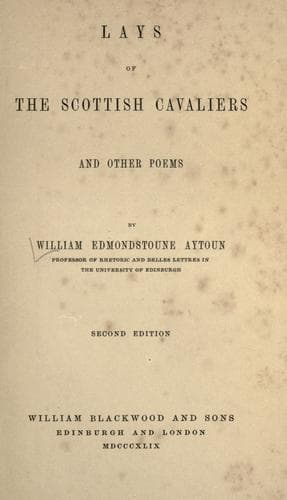
Lays of the Scottish Cavaliers and Other PoemsAytoun, William Edmondstoune
History
Lays of the Scottish Cavaliers and Other Poems
Aytoun, William Edmondstoune
Scotland -- History -- Poetry
After the battle of Killiecrankie the cause of the Scottish royalists
declined, rather from the want of a competent leader than from any
disinclination on the part of a large section of the nobility and gentry
to vindicate the right of King James. No person of adequate talents or
authority was found to supply the place of the great and gallant Lord
Dundee; for General Cannon, who succeeded in command, was not only
deficient in military skill, but did not possess the confidence, nor
understand the character of the Highland chiefs, who, with their
clansmen, constituted by far the most important section of the army.
Accordingly no enterprise of any importance was attempted; and the
disastrous issue of the battle of the Boyne led to a negotiation which
terminated in the entire disbanding of the royal forces. By this treaty,
which was expressly sanctioned by William of Orange, a full and
unreserved indemnity and pardon was granted to all of the Highlanders
who had taken arms, with a proviso that they should first subscribe the
oath of allegiance to William and Mary, before the 1st of January, 1692,
in presence of the Lords of the Scottish Council, "or of the Sheriffs or
their deputies of the respective shires wherein they lived." The letter
of William addressed to the Privy Council, and ordering proclamation to
be made to the above effect, contained also the following significant
passage:--"That ye communicate our pleasure to the Governor of
Inverlochy, and other commanders, that they be exact and diligent in
their several posts; but that they show no more zeal against the
Highlanders after their submission, _than they have ever done formerly
when these were in open rebellion_."
This enigmatical sentence, which in reality was intended, as the sequel
will show, to be interpreted in the most cruel manner, appears to have
caused some perplexity in the Council, as that body deemed it necessary
to apply for more distinct and specific instructions, which, however,
were not then issued. It had been especially stipulated by the chiefs,
as an indispensable preliminary to their treaty, that they should have
leave to communicate with King James, then residing at St. Germains, for
the purpose of obtaining his permission and warrant previous to
submitting themselves to the existing government. That article had been
sanctioned by William before the proclamation was issued, and a special
messenger was despatched to France for that purpose.
Public-domain text, read in full here on John Shaqi.
Reviews
Reviews
No reviews yet
Be the first to share your thoughts on this work.
Join the Discussion
Join the discussion
Sign in to leave a comment or review.
Sign InorCreate an account