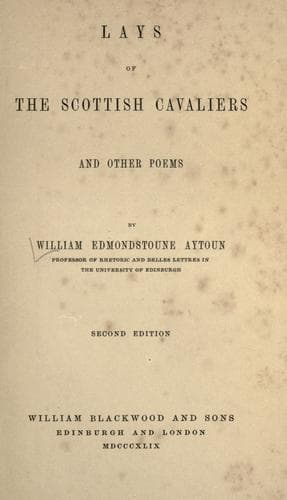
Lays of the Scottish Cavaliers and Other Poems — John Shaqi
Lays of the Scottish Cavaliers and Other PoemsAytoun, William Edmondstoune
History
Lays of the Scottish Cavaliers and Other Poems
Aytoun, William Edmondstoune
Scotland -- History -- Poetry
understood that the Germans were beat out of the island, he made the
sign of the cross on his face and breast, and declared publicly, that it
was the bravest action that ever he saw, and that his army had no honour
by it. As soon as the boats came, the Marquis sent into the island to
acquaint the officers that he would send them both troops and
provisions, who thanked his Excellency, and desired he should be
informed that they wanted no troops, and could not spare time to make
use of provisions, and only desired spades, shovels, and pickaxes,
wherewith they might intrench themselves--which were immediately sent to
them. The next morning, the Marquis came into the island, and kindly
embraced every officer, and thanked them for the good service they had
done his master, assuring them he would write a true account of their
honour and bravery to the Court of France, which, at the reading his
letters, immediately went to St. Germains, and thanked King James for
the services his subjects had done on the Rhine."
The company kept possession of the island for nearly six weeks,
notwithstanding repeated attempts on the part of the Germans to surprise
and dislodge them; but all these having been defeated by the extreme
watchfulness of the Scots, General Stirk at length drew off his army and
retreated. "In consequence of this action," says the chronicler, "that
island is called at present Isle d'Ecosse, and will in likelihood bear
that name until the general conflagration."
Two years afterwards, a treaty of peace was concluded; and this gallant
company of soldiers, worthy of a better fate, was broken up and
dispersed. At the time when the narrative, from which I have quoted so
freely, was compiled, not more than sixteen of Dundee's veterans were
alive. The author concludes thus,--"And thus was dissolved one of the
best companies that ever marched under command! Gentlemen, who, in the
midst of all their pressures and obscurity, never forgot they were
gentlemen; and whom the sweets of a brave, a just, and honourable
conscience, rendered perhaps more happy under those sufferings, than the
most prosperous and triumphant in iniquity, since our minds stamp our
happiness."
Some years ago, while visiting the ancient Scottish convent at Ratisbon,
my attention was drawn to the monumental inscriptions on the walls of
the dormitory, many of which bear reference to gentlemen of family and
distinction, whose political principles had involved them in the
troubles of 1688, 1715, and 1745. Whether the cloister which now holds
their dust had afforded them a shelter in the later years of their
misfortunes, I know not; but for one that is so commemorated, hundreds
of the exiles must have passed away in obscurity, buried in the field on
which they fell, or carried from the damp vaults of the military
hospital to the trench, without any token of remembrance, or any other
wish beyond that which the minstrels have ascribed to one of the
greatest of our olden heroes--
Public-domain text, read in full here on John Shaqi.
Reviews
Reviews
No reviews yet
Be the first to share your thoughts on this work.
Join the Discussion
Join the discussion
Sign in to leave a comment or review.
Sign InorCreate an account