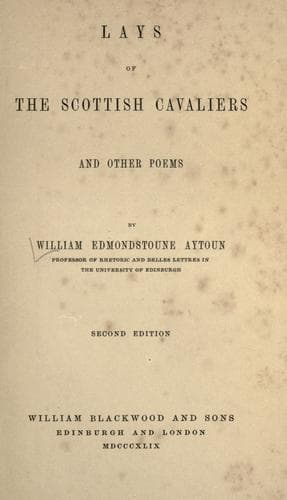
Lays of the Scottish Cavaliers and Other PoemsAytoun, William Edmondstoune
History
Lays of the Scottish Cavaliers and Other Poems
Aytoun, William Edmondstoune
Scotland -- History -- Poetry
The campaign of 1745 yields in romantic interest to none which is
written in history. A young and inexperienced prince, whose person was
utterly unknown to any of his adherents, landed on the west coast of
Scotland, not at the head of a foreign force, not munimented with
supplies and arms, but accompanied by a mere handful of followers, and
ignorant of the language of the people amongst whom he was hazarding his
person. His presence in Scotland had not been urged by the chiefs of the
clans, most of whom were deeply averse to embarking in an enterprise
which must involve them in a war with so powerful an antagonist as
England, and which, if unsuccessful, could only terminate in the utter
ruin of their fortunes. This was not a cause in which the whole of
Scotland was concerned. Although it was well known that many leading
families in the Lowlands entertained Jacobite opinions, and although a
large proportion of the common people had not yet become reconciled to,
or satisfied of, the advantages of the Union, by which they considered
themselves dishonoured and betrayed, it was hardly to be expected that,
without some fair guarantee for success, the bulk of the Scottish nation
would actively bestir themselves on the side of the exiled family.
Besides this, even amongst the Highlanders there was not unanimity of
opinion. The three northern clans of Sutherland, Mackay, and Monro, were
known to be staunch supporters of the Government. It was doubtful what
part might be taken in the struggle by those of Mackenzie and Ross. The
chiefs of Skye, who could have brought a large force of armed men into
the field, had declined participating in the attempt. The assistance of
Lord Lovat, upon whom the co-operation of the Frasers might depend,
could not be calculated on with certainty; and nothing but hostility
could be expected from the powerful sept of the Campbells. Under such
circumstances, it is little wonder if Cameron of Locheill, the most
sagacious of all the chieftains who favoured the Stuart cause, was
struck with consternation and alarm at the news of the Prince's
landing, or that he attempted to persuade him from undertaking an
adventure so seemingly hopeless. Mr. Robert Chambers, in his admirable
history of that period, does not in the least exaggerate the importance
of the interview, on the result of which the prosecution of the war
depended. "On arriving at Borrodale, Locheill had a private interview
with the Prince, in which the probabilities of the enterprise were
anxiously debated. Charles used every argument to excite the loyalty of
Locheill, and the chief exerted all his eloquence to persuade the Prince
to withdraw till a better opportunity. Charles represented the present
as the best possible opportunity, seeing that the French general kept
the British army completely engaged abroad, while at home there were no
troops but one or two newly-raised regiments. He expressed his
Public-domain text, read in full here on John Shaqi.
Reviews
Reviews
No reviews yet
Be the first to share your thoughts on this work.
Join the Discussion
Join the discussion
Sign in to leave a comment or review.
Sign InorCreate an account