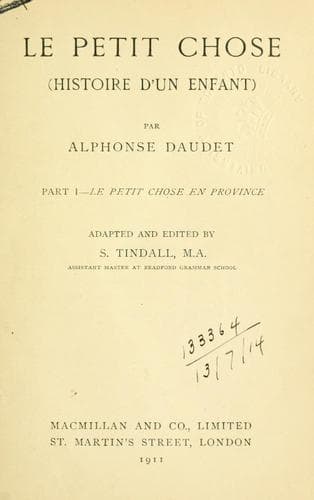
Le Petit Chose (Histoire d'un Enfant)Daudet, Alphonse
General
Le Petit Chose (Histoire d'un Enfant)
Daudet, Alphonse
Autobiographical fiction; Bildungsromans; French fiction -- 19th century; French language -- Readers
But the pupils — the young noblemen! Pale and haggard faces, lank and
bony figures, children with countenances of old men, deformities with irons
upon their limbs, boys of stunted growth, and others whose long meagre legs
would hardly bear the stooping bodies, all crowded on the view together.
There was every ugliness or distortion that told of unnatural aversion
conceived by parents for their offspring, or of young lives which, from
the earliest dawn of infancy, had been one horrible endurance of cruelty
and neglect. There were little faces which should have been handsome,
darkened with the scowl of sullen, dogged suffering. There was childhood
with the light of its eye quenched, its beauty gone, and its helplessness
alone remaining; there were vicious-faced boys, brooding, with leaden eyes,
like malefactors in jail; and there were young creatures on whom the sins
of their frail parents had descended, weeping even for the mercenary nurses
they had known, and lonesome even in their loneliness. With every kindly
sympathy and affection blasted in its birth, with every young and healthy
feeling flogged and starved down, with every revengeful passion that can
fester in swollen hearts, eating its evil way to their core in silence,
what an incipient Hell was breeding here!—From DICKENS’S _Nicholas
Nickleby_.
VI
It is not only his nerves which are sensitive, it is also his heart,
and the keenness of his sensations is equalled by that of his sympathies.
He is interested in his characters, and it is by loving them that he makes
us love them. If the figures he paints give us a life-like impression,
it is because they lived not only in his imagination but also in his
heart.… Daudet can feel in his heart that love which Dickens felt
towards those who are ill-favoured or poor. His favourite heroes are
especially those who are sensitive, and who are made wretched by their
sensitiveness. In order to create _Jack_ he left the _Nabab_, which he
had already begun, and wrote in less than a year that book which is at
the same time tender and cruel, but in which cruelty is only another
form of tenderness, and which so oppressed the heart of George Sand that
after reading it she, the indefatigable worker, remained for three whole
days without being able to produce anything at all.—From PELLISSIER,
_Le Mouvement littéraire au XIXe siècle_.
VII
Public-domain text, read in full here on John Shaqi.
Reviews
Reviews
No reviews yet
Be the first to share your thoughts on this work.
Elsewhere in the archive
Join the Discussion
Join the discussion
Sign in to leave a comment or review.
Sign InorCreate an account