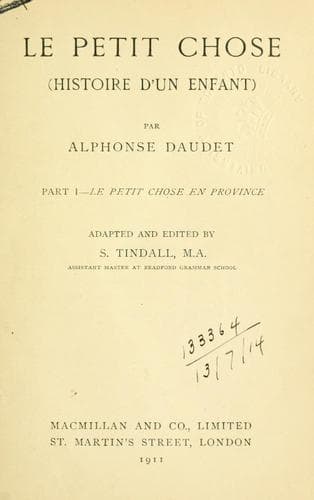
Le Petit Chose (Histoire d'un Enfant)Daudet, Alphonse
General
Le Petit Chose (Histoire d'un Enfant)
Daudet, Alphonse
Autobiographical fiction; Bildungsromans; French fiction -- 19th century; French language -- Readers
It was not very large certainly, being about six feet long by four broad.
It could not be called light, as there were bars and a grating to the
window. But it was uncommonly comfortable to look at. The space under
the window at the farther end was occupied by a square table covered with
a reasonably clean and whole red and blue tablecloth; a hard-seated sofa
covered with red stuff occupied one side; and a good stout wooden chair
afforded a seat for another boy, so that three could sit and work
together. Over the door were a row of hat-pegs, and on each side
book-cases with cupboards at the bottom; shelves and cupboards being
filled indiscriminately with school-books, a cup or two, a mouse-trap and
brass candlesticks, leather straps, and some curious-looking articles
which puzzled Tom not a little, until his friend explained that they were
climbing-irons, and showed their use. A cricket-bat and small fishing-rod
stood up in one corner.—From HUGHES’S _Tom Brown’s School-days_.
VIII
Daudet’s imagination does not consist in the invention of facts
or characters: he pictures to himself with extraordinary vividness
what has passed before his eyes. Though they are marvellously real,
his scenes have not that precise and strict perfection which Flaubert
used to give to his. He catches in mid-flight the faintest details and
holds fast their very movement. The vibration is still there, and one
can feel the tremor in the air and the play of the light.
As to his human figures, I question whether Daudet has ever had his
equal in the picturesque truthfulness of his portraits, in the capacity
of reproducing the expression of a face, an attitude or dress.
And it does not follow that, as certain “psychological” writers have
hinted, Daudet was deficient in “psychology.” We cannot find in him that
cold, pedantic psychology which consists of the authors’s own reflections;
and if, to be a “psychologist,” it is necessary to explain minutely every
step and every gesture, or to put wearisome commentaries in the place
of action, Daudet does not deserve the name. But perhaps there is a
distinction to be made between a novel and an anatomical treatise.
—From PETIT DE JULLEVILLE, _Hist. de la litt. fr_. vol. viii.
IX
Public-domain text, read in full here on John Shaqi.
Reviews
Reviews
No reviews yet
Be the first to share your thoughts on this work.
Elsewhere in the archive
Join the Discussion
Join the discussion
Sign in to leave a comment or review.
Sign InorCreate an account