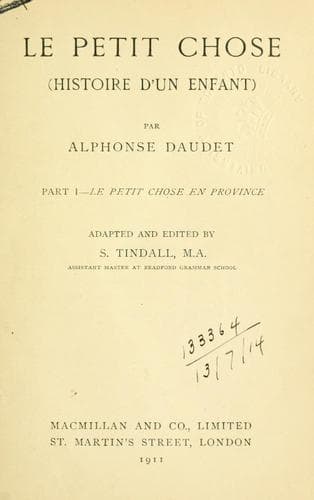
Le Petit Chose (Histoire d'un Enfant)Daudet, Alphonse
General
Le Petit Chose (Histoire d'un Enfant)
Daudet, Alphonse
Autobiographical fiction; Bildungsromans; French fiction -- 19th century; French language -- Readers
28. le lendemain soir: note this is the correct way of
expressing in French ‘next evening’; cf. _le lendemain matin_.
Page 14.
17. s’y maria, ‘got married there.’ Note _marier_, ‘to give in marriage,’
or ‘to perform the marriage ceremony’; e.g. _le curé les a
mariés; se marier avec_, ‘to be married to,’ e.g. _elle s’est
mariée avec Monsieur B_., or _elle a épousé Monsieur B_.
20. gros ouvrage, ‘rough work.’
26. par exemple: see note, p. 3 l. 22.
27. lui non plus, ‘either,’ added for emphasis at the end of the
sentence.
29. avait fini par le prendre en grippe, ‘had at length taken a
dislike to him.’
l’abreuvait de taloches, ‘rapped his head at every turn.’
31. le fait est: a favourite expression of Daudet. It does not
correspond to the English ‘the fact is,’ which generally denotes
a contradiction, but rather strengthens what has been said.
Trans. ‘indeed.’
Page 15.
2. perdait tous ses moyens, ‘completely lost his wits.’
9. le voilà qui prend: the use of _le voilà_ is very emphatic;
_voi_ is the imperative of _voir_, and _le voilà=vois-le là_.
18. tu as beau lui dire, ‘it is no use your telling him.’ _Avoir
beau_ + infinitive is ironical, and elliptical for _avoir beau
temps pour_, i.e. to have a fine opportunity, but to no purpose;
cf. the English ‘it is all very _fine_ for you to tell him.’
19. tout de même: see note, p. 10 l. 3.
30. pourvu qu’il ne lui soit rien arrivé, ‘I hope nothing has
happened to him.’
31. parbleu: a euphemism for _pardieu_. Trans. ‘why, of course not.’
Page 16.
15. recteur: as far as education is concerned, France is
divided into seventeen _académies_, each under a _recteur_,
who represents the _Ministre de l’instruction publique_.
24. de bonne foi, ‘honestly’; cf. _de bon cœur_, ‘gladly’
(p. 35 l. 28); _de meilleur cœur_, ‘more cheerfully,’
‘more willingly’ (p. 49 l. 27).
28. non plus: see note, p. 14 l. 27.
Page 17.
1. gones: provincial slang, ‘street arabs.’
2. blouse à carreaux: note the French _à_ of description
where we say ‘with’; cf.—
p. 33 l. 14, _un personnage à favoris rouges_.
p. 35 l. 20, _la fée aux lunettes_.
p. 35 l. 24, _l’ homme aux moustaches_.
p. 42 l. 20, _l’ homme aux clefs_.
p. 52 l. 28, _ses souliers à boucles_.
5. Tiens! expresses surprise and may be rendered, according to
the context, by ‘here!’ ‘look here!’ ‘I say!’ ‘halloa!’
‘well, I never!’ etc.
6. me prit en aversion, ‘took a violent dislike to me’;
cf. note, p. 14 l. 29.
7. du bout des lèvres, ‘in a most casual manner’; cf. _rire du
tout des lèvres_.
16. sentaient bon, ‘smelt very nice.’ For other adjectives
used as adverbs cf. _parlant haut_ (p. 40 l. 27);
_il s’arrêta court_ (p. 43 l. 26); _ne pas manger
tranquille_ (p 51 l. 23); _prier ferme_ (p. 56 l. 2);
_il s’arrêta net_ (p. 98 l. 1).
Public-domain text, read in full here on John Shaqi.
Reviews
Reviews
No reviews yet
Be the first to share your thoughts on this work.
Elsewhere in the archive
Join the Discussion
Join the discussion
Sign in to leave a comment or review.
Sign InorCreate an account