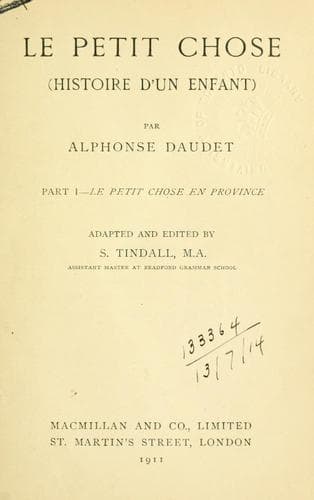
Le Petit Chose (Histoire d'un Enfant)Daudet, Alphonse
General
Le Petit Chose (Histoire d'un Enfant)
Daudet, Alphonse
Autobiographical fiction; Bildungsromans; French fiction -- 19th century; French language -- Readers
20. moisis, fanés, sentant le rance, ‘mouldy, musty and
frowsy.’ _Sentir le rance_, ‘to smell rancid,’ lit.
‘to smell of rancidity’ (cf. _sentir le vin, le tabac_,
etc.). The term ‘rancid’ could not be applied here.
In English it is only used of _oil_ and similar substances.
22. faisait bien de son mieux, ‘did indeed his very best.’
Page 18.
4. boursier, ‘foundation scholar’; cf. the Scotch ‘bursar.’
6. ma foi! see note, p. 11 l. 19.
10. le givre fouettait les vitres, ‘the frozen rain was
beating against the window-panes.’
13. j’ai reçu votre honorée du 8 courant, ‘I have received
your favour of the 8th instant.
Page 19. (chapter iii. full=iv)
6. fermer à double tour, ‘double-lock.’
16. pour toute réponse, ‘by way of answer.’
17. veste, ‘jacket’ _gilet_=‘vest,’ ‘waistcoat.’
Page 20.
7. songez donc! ‘just think!’
10. qu’il n’y avait encore de fait que les quatre premiers
vers, ‘that the first four lines only were done so far.’
17. jamais il n’en put venir a bout, ‘he could never get
through.’ _En_ is used here as the object, _ce reste_,
to which it refers, precedes the verb for the sake of
emphasis. Note _n’en put_, somewhat archaic for _ne put en…_
18. que voulez-vous? ‘there is no help for it!’ See note, p. 5 l. 12.
21. le poète eut beau faire: see note, p. 15 l. 18.
Page 21.
1. parbleu! ‘of course!’ See note, p. 15 l. 31.
3. si le lecteur le veut bien, ‘if the reader has an objection.’
Note _lecteur, lectrice_, ‘reader’; _lecture_, ‘reading’;
_conférence_, ‘lecture’; _conférencier_, ‘lecturer.’
4. est en train de: cf. _être en train de travailler_,
‘to be busy working.’
5. enjambée: the suffix _-ée_ denotes _quantity_; e.g.
p. 36 l. 5, _poignée_, ‘handful’; p. 47 l. 2, _nuée_,
‘thick cloud,’ ‘swarm.’
12. la même chanson, ‘the same old tune.’
13. misère, ‘poverty,’ ‘want,’ _not_ misery’;
_les misères_, ‘hardships’; une misère, ‘a trifle.’
les affaires qui ne vont pas, ‘business not prospering.’
en retard, ‘in arrears,’ ‘to be paid up.’
15. l’argenterie au mont-de-piété, ‘the pawning of the family plate.’
Monts-de-piété, ‘pawnshops,’ were founded out of piety to enable
people in straitened circumstances to escape the exorbitant usury
of the Jews, and borrow money at a reasonable rate of interest.
The most ancient of these was established at Perugia, 1477, and
situated on a _mountain_; hence its name. The name and system
were introduced into France, where these institutions were put
under Government control. Had such benevolent establishments
only been introduced into England under the same conditions
thousands of people might have been saved from utter ruin.
19. huissier, ‘bailiff,’ lit, one who keeps the _huis_ or ‘door.’
Public-domain text, read in full here on John Shaqi.
Reviews
Reviews
No reviews yet
Be the first to share your thoughts on this work.
Elsewhere in the archive
Join the Discussion
Join the discussion
Sign in to leave a comment or review.
Sign InorCreate an account