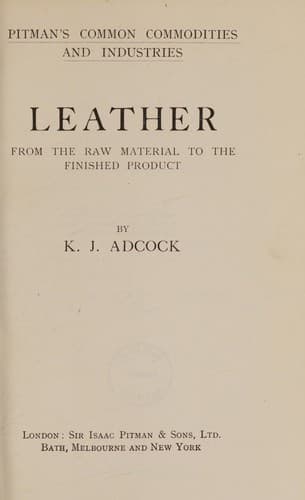
Leather: From the Raw Material to the Finished ProductAdcock, K. J.
History
Leather: From the Raw Material to the Finished Product
Adcock, K. J.
Leather
The process of dyeing is least troublesome and most effective when
done in the drum tumbler. The leather is run in warm water until the
temperature reaches 140°-150° F (60°-66° C.) and the dyeing materials
are added gradually in a box at the side of the drum whence it passes
through the axle or journal into the tumbler. Although chrome leather
is not materially affected by boiling water in contradistinction
to vegetable-tanned leather, which cannot be treated with water
above 60° C. without injury, it is inadvisable to dye it in
boiling solutions, the above-mentioned temperature being the most
satisfactory. There are two methods of dyeing blacks in the leather
trade: (1) the logwood-ammonia, and (2) the aniline black. The former
is the cheaper of the two and quite satisfactory, although many
dyers seem to prefer the aniline process. The latter certainly gives
a deeper black, but it is not at all necessary to make the flesh side
of box calf black, and many buyers prefer the back blue, although, of
course, the grain side of the leather must be finished a jet black.
The crude logwood is generally subjected to a process of fermentation
or "ageing." The new wood has to be placed on stone or cemented
flooring in a warm room and frequently turned over until fermentation
has ceased, which usually takes about a week. It is then cut into
small chips by machinery and packed in bags. This is the form in
which it always used to enter the tannery, but it is now generally
prepared in paste or crystal extract by makers of tanning and
dye-wood extracts, a business which grows in importance every year.
The colouring matter of logwood is haematoxylin, which is converted
into haematin by oxidation; hence, the extract is often referred to
as haematin crystals. The paste may be used where it is desirable
to increase the substance of the leather, but most dyers prefer
the crystals, which are easily dissolved in hot water. One lb. of
crystals, to which is added just enough ammonia to change the brown
colour to violet blue, suffices for each 100 lb. of leather dyed. The
colouring matter is absorbed by the time the drum has been running
half an hour, leaving clear water behind. The next process is known
technically as "fat-liquoring," which, as its name implies, consists
in lubricating the fibres of the leather with fatty or oily matters.
This is a very important process, for, when suitable ingredients
are used, the pliability, strength, and waterproof quality of the
leather are greatly increased. The making of special fat-liquors for
different kinds of leather has become quite an important business,
and most makes can be depended upon for the specified purposes. It
is a debatable point as to whether fat-liquoring should precede or
follow dyeing. Generally speaking, it is better to adopt the latter
course, as the fatty ingredients help to fix the colouring matter on
the fibres of the leather. The dye is also less liable to fade when
fat liquoring follows the colouring.
Public-domain text, read in full here on John Shaqi.
Reviews
Reviews
No reviews yet
Be the first to share your thoughts on this work.
Elsewhere in the archive
Join the Discussion
Join the discussion
Sign in to leave a comment or review.
Sign InorCreate an account