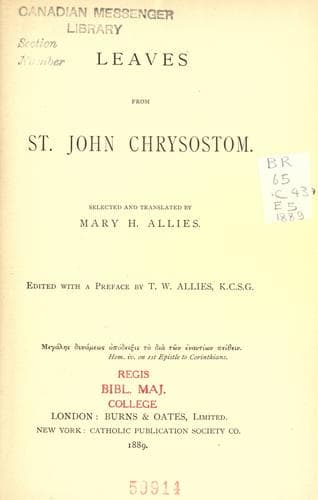
Leaves from St. John ChrysostomJohn Chrysostom, Saint
Religion
Leaves from St. John Chrysostom
John Chrysostom, Saint
Christian literature, Early; John Chrysostom, Saint, -407
their feelings, so that from what they themselves experience they should
extend pardon to others. God has always pursued this course, not only
now but of old: He allowed those to whom He was going to entrust His
Church and His people to fall into sin, so that on account of their own
shortcomings they might become merciful to others. If they had _not_
sinned, they would not have made a single excuse for sinners, but,
wholly merciless, would have excluded all from the Church. Let me show
you by an example that it _is_ so, and that I do not speak from
conjecture. Peter was to be entrusted with the keys of heaven and with
the multitude of the people. For what were the Lord’s words to him?
_Whatsoever thou shalt bind on earth shall_ _be bound in heaven, and
whatsoever thou shalt loose on earth shall be loosed in heaven._ For
Peter was somewhat severe, and if he had been faultless how would he
have excused his disciples? This was why the Divine Goodness brought
about a certain fall on his part, that from what he himself experienced,
he might become kind to others. And consider the man who is allowed to
fall into sin,—Peter, the chief of the Apostles, the irremovable
foundation, the immutable rock, the leader of the Church, the sure
harbour, the invincible pillar. Peter it was who had said to Christ,
_Even if I should die with Thee I will not desert Thee_; Peter who had
confessed the truth by divine revelation: _Thou art Christ the Son of
the living God_: this Peter going in on the night of Christ’s betrayal
and standing by the fire to warm himself, a certain maid-servant went up
to him and said, _Yesterday thou wert with this man_, and Peter
answered, _I know not the man_. Just before he had said, _Even if I
should die with Thee_; now he denies Him and says, _I know not the man_.
O Peter! is this thy promise? Thou hast not endured torments nor
stripes, but at a single word from a maid-servant—thou hast denied. Wilt
thou deny, Peter? As yet there are neither torments, nor stripes, nor
blows, nor angry passions, nor princes, nor outstretched swords, neither
edicts, nor threatening emperors, nor sentence to death, neither
prisons, nor precipices, nor seas. There are none of these things, yet
thou hast already denied Him: _I know not the man_. Again the maid said
to him, _Yesterday thou wert with this man._ And he answered her: _I
know not the man_. Who is making thee deny? No one in authority, but a
woman, and she a poor doorkeeper, a captive unworthy of an answer: at
_her_ word thou deniest! This is wonderful indeed! A maid-servant, a
harlot going up to Peter disturbed his faith. Peter, the pillar,
suffered no temptation: she only opened her mouth and that pillar was
shaken, that bulwark was moved. What seest thou before thee, Peter,
whilst thou deniest? A miserable maid-servant, a wretched doorkeeper.
This is what thou seest, and dost thou deny? Now for the third time she
says: _Yesterday thou too wert with this man_, and he denied for the
third time.
Public-domain text, read in full here on John Shaqi.
Reviews
Reviews
No reviews yet
Be the first to share your thoughts on this work.
Elsewhere in the archive
Join the Discussion
Join the discussion
Sign in to leave a comment or review.
Sign InorCreate an account