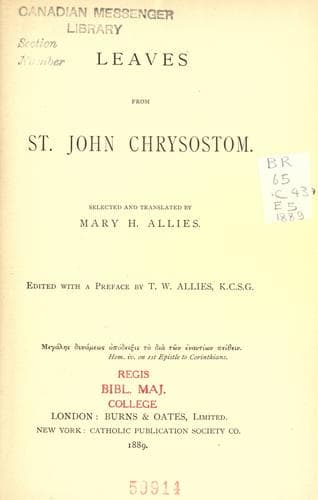
Leaves from St. John ChrysostomJohn Chrysostom, Saint
Religion
Leaves from St. John Chrysostom
John Chrysostom, Saint
Christian literature, Early; John Chrysostom, Saint, -407
And Jesus looking at him, recalled his own words to his
mind, and he began to weep tears of contrition for his sin. Still Jesus
pardoned him, knowing that as a man he had had a human weakness. But as
I have said, on this account He was about to entrust him with a whole
people, so that, not being hard or without sin, he might not be without
mercy for his own brethren. He fell into sin, that, considering his own
fault and his Lord’s pardon, he also might extend a merciful forgiveness
to others, which, according to divine dispensation should reconcile them
to God. He who was to be entrusted with the Church was allowed to sin;
the pillar of the churches, the harbour of faith, Peter the teacher of
the world, was allowed to sin in order that his forgiveness might become
the basis of mercy for others. Why do I say these things? Because we
priests who sit upon a throne and teach are fettered by sins. This is
why neither angel nor archangel has been entrusted with the priesthood,
for _they_ are without sin, in order that they should not through
severity at once strike down sinners amongst the people. A man born of
man was entrusted with this throne, a man held subject himself to
pleasure and to sin, so that in receiving a sinner, mindful of his own
failings, he might be gentler to that sinner. For if the priest were an
angel and were to receive a dissolute man, he would kill him on the
spot, not being acquainted with this passion. On this account if an
angel had the sacerdotal authority, he would not teach, but he would
kill the man in anger through his not being an angel: for this reason it
was a man with the knowledge and experience of his own faults, that he
might pardon sinners, and not be moved by anger, that the Church might
not be vacant through the Synagogue.
· · · · · · ·
The Authority of the Priest.
(_On the Priesthood_,[17] b. iii., c. iv., p. 24.)
Public-domain text, read in full here on John Shaqi.
Reviews
Reviews
No reviews yet
Be the first to share your thoughts on this work.
Elsewhere in the archive
Join the Discussion
Join the discussion
Sign in to leave a comment or review.
Sign InorCreate an account