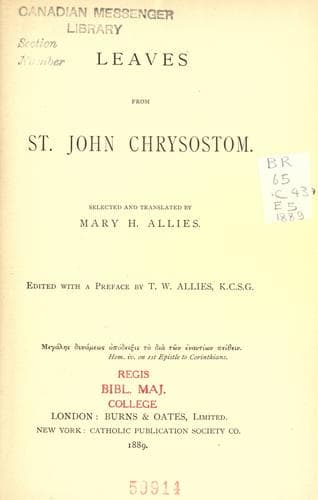
Leaves from St. John ChrysostomJohn Chrysostom, Saint
Religion
Leaves from St. John Chrysostom
John Chrysostom, Saint
Christian literature, Early; John Chrysostom, Saint, -407
Tell me what need was there of having many sacrifices when one is
sufficient? That there being many which were constantly offered might
show their inefficacy for purification. Just as a powerful remedy, which
is productive of health and able to remove all the malady, does
everything by one application, and when this one application does
everything, it shows its strength in not being applied again; and this
is also its work, for if it be always used it is a sign that it has no
efficacy. The merit of a remedy consists in being applied once and not
often. And so it is here. Why, then, are they always cured by the same
sacrifices? If they had been free from all sin, sacrifices would not
have been offered up every day. Therefore, they were fixed things, so as
to be invariably offered up for all the people both in the evening and
in the morning. Thus, it was a confession of sins, not a remission of
sins; a confession of weakness, not a manifestation of strength. Since
the first sacrifice availed nothing the second was offered up, and that
also proving ineffectual another followed, so that it was an
acknowledgment of guilt. On the one hand, the act of offering was a
confession of sin, and the ever-recurring offering was a confession of
weakness. Now, with Christ it was the contrary. He was once offered up,
and His one oblation sufficed for all time. He expressed it well by
calling them images, for they present the figure only and not the
strength of the reality. Just as an image represents the likeness of a
man but not his power, so the truth and the figure have something in
common with each other. The likeness is the same but not the living
power. So it was in the matter of heaven and the tabernacle. The figure
was equal, for it was holy; but the power and the other qualities were
not the same. What is the meaning of _He hath appeared for the putting
away of sin by the sacrifice of Himself_? What is the _putting away_?
Contempt; for sin has no longer any assurance. It has been put away.
How? Whereas it should have paid a penalty it did not, that is, force
was put upon it; for just when it was likely to destroy all men it was
itself taken away. _He hath been made manifest_, he says, _by the
sacrifice of Himself_; that is, He was manifested to God and went to
God. Now, because the priest did this many times in the year, do not
think that this has taken place by chance and not through weakness. If
not through weakness, why then did it take place? If there are no
wounds, then neither are remedies necessary. Therefore, He enjoined that
the sacrifice should be always offered up on account of weakness, and
that it should take place as a commemoration of sins. What then? Do we
not offer up sacrifice day by day? We do indeed, but we commemorate His
death. This sacrifice is one, not many. How one and not many? Because it
was once offered up, just as that one sacrifice in the holy of holies.
This is a type of that, and that of the other.
Public-domain text, read in full here on John Shaqi.
Reviews
Reviews
No reviews yet
Be the first to share your thoughts on this work.
Elsewhere in the archive
Join the Discussion
Join the discussion
Sign in to leave a comment or review.
Sign InorCreate an account