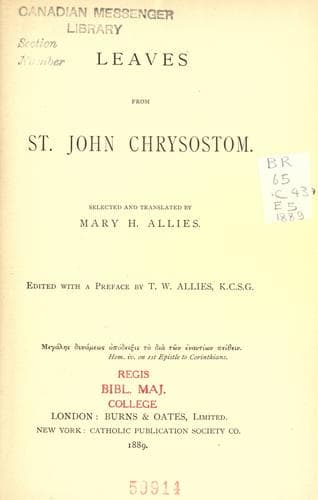
Leaves from St. John ChrysostomJohn Chrysostom, Saint
Religion
Leaves from St. John Chrysostom
John Chrysostom, Saint
Christian literature, Early; John Chrysostom, Saint, -407
We are ever offering up
the same Person. Not one sheep to-day and another to-morrow, but ever
the same sheep, so that the sacrifice is one. Now, in virtue of this
argument, since the sacrifice is offered up in many places, are there
many Christs? By no means, but there is everywhere one Christ, as
perfect in one place as in another, one body. Therefore, as He Who is
offered up in many places is one Body and not many bodies, so is it one
Sacrifice. He is our High Priest Who offered up the sacrifice which
purifies us. This is that which now also we offer up; the One then
offered up, the Inconsumable. This is done in commemoration of what was
then done, for He says, _This do in commemoration of Me_. We are ever
offering not another sacrifice, as the high priest then did, but always
the same; or rather we make a commemoration of a sacrifice. And since I
have spoken of this sacrifice, I would say a few things to you who are
initiated, a few things in volume though possessing great power and
help. What we speak is not ours but the Divine Spirit’s. What, then, is
it? Many partake of this sacrifice once in the whole year, some twice,
some often. Now, we speak to all, not only to those who are here, but to
those who dwell in the desert. For they receive once a year, often,
indeed, once in two years. Well, then, whom shall we prefer? Those who
receive once, or those who receive twice, or those who receive often?
Neither those who receive once, nor those who receive often, nor those
who receive seldom, but those who receive with a pure conscience, and an
undefiled heart, and an irreproachable life. Let such as these ever
approach, and those who are not so not even once. Why? Because they take
judgment to themselves, and condemnation, and chastisement, and penalty.
Wonder not at this. For just as food, which by its nature is nourishing,
if taken by a diseased stomach, destroys and withers up everything and
prepares disease, so is it with this case of the tremendous mysteries.
You are partaking of a spiritual table, of a royal table, and do you
again fill your mouth with mud? You use perfumes, and do you again fill
yourself with ill odours? Tell me, I beseech you, if you receive
communion once a year, will forty days suffice you for the atonement of
your sins during all that time? Again, at the end of a week perhaps, you
return to your former ways. Now, tell me, if you were to enjoy good
health for forty days after a long illness, and then were to go back to
unwholesome food productive of disease, would you not waste your
trouble? Evidently you would. If physical things are so changed, how
much more those which belong to the will. Thus for instance, we see by
nature, and we have naturally a healthy sight. But often our eyes fail
from disease. If, therefore, natural things are so mutable, how much
more that which is a matter of free-will! You give up forty days to the
care of your soul’s health, often not even that, and you think to have
Public-domain text, read in full here on John Shaqi.
Reviews
Reviews
No reviews yet
Be the first to share your thoughts on this work.
Elsewhere in the archive
Join the Discussion
Join the discussion
Sign in to leave a comment or review.
Sign InorCreate an account