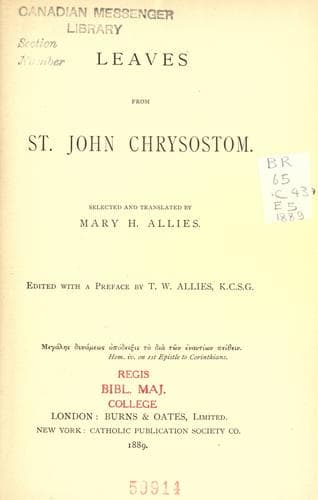
Leaves from St. John ChrysostomJohn Chrysostom, Saint
Religion
Leaves from St. John Chrysostom
John Chrysostom, Saint
Christian literature, Early; John Chrysostom, Saint, -407
_And whilst they were at supper, Jesus took bread, and blessed, and
broke, and gave to His disciples, and said: Take ye and eat: this is My
Body. And taking the chalice, He gave thanks, and gave to them, saying:
Drink_ _ye all of this; for this is my Blood of the new testament, which
shall be shed for many unto remission of sins._ Consider what great
hardness of heart the traitor showed. Partaking of the mysteries, he
remained the same, and enjoying that most tremendous Banquet, he was not
converted. This Luke plainly intimates when he says that after these
things the devil entered into him, not despising the Lord’s Body, but
scorning the traitor’s shamelessness. For his sin was the greater for
two reasons: that he approached the mysteries with such a mind, and
that, approaching them, he grew no better. Neither fear, nor gratitude,
nor the honour received, had any influence over him. And although Christ
knew all things, He did not forbid his approach in order to show you
that He leaves no means of conversion untried. Therefore, both before
this and after this, He continued to exhort and to check Judas both by
actions and words, by fear and by kindness, by threat and by benefit.
But nothing availed against that grievous sickness of his. Hence,
leaving Judas to himself, He again reminds the disciples through the
mysteries of His death as victim, and during the progress of the table
discourses about the Cross, seeking, by His insistence in foretelling
His passion, to find an entrance for it in their minds. If, with all
that was done and foretold, they were troubled, what would they have
suffered if they had heard none of these things? _Whilst they were
eating, He took bread and broke it._ Why did he carry out this mystery
at the time of the Pasch? In order to teach you everywhere that He is
Himself the Lawgiver of the old dispensation, also, and that its
ordinances were made to foreshadow these things. On this account He adds
the reality to the type. The evening signified the fulness of time, and
the end itself to which things were coming. He gives thanks, teaching us
how we are to carry out this mystery, and showing us that He goes not
unwillingly to the Cross. And He instructs us that, whatever we may
suffer, we should bear it with thanksgiving, and opens out from this
good hopes for us. For if the type released men from so grievous a
slavery, how much more will the reality set the world free, and be
bestowed for the blessing of our nature. For this reason He did not
institute this mystery until the enactments of the Law were to cease,
and He brings to a conclusion the chief of their feasts by translating
them to another and a most awful Table, and says: _Take and eat, this is
My Body which is broken for many_. How should they not have feared when
they heard this? He had spoken to them often and much before on the same
subject. Therefore, He no longer prepares them for it, for they had
Public-domain text, read in full here on John Shaqi.
Reviews
Reviews
No reviews yet
Be the first to share your thoughts on this work.
Elsewhere in the archive
Join the Discussion
Join the discussion
Sign in to leave a comment or review.
Sign InorCreate an account