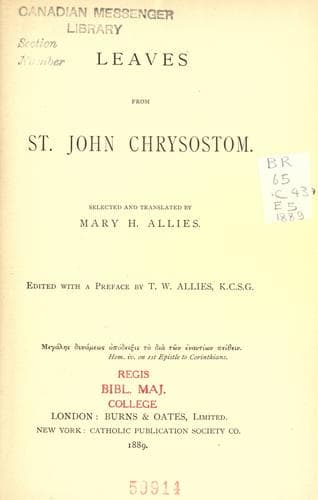
Leaves from St. John ChrysostomJohn Chrysostom, Saint
Religion
Leaves from St. John Chrysostom
John Chrysostom, Saint
Christian literature, Early; John Chrysostom, Saint, -407
heard of it sufficiently; but He tells them the reason why He
suffers—the remission of sins. He calls His Blood the Blood of the new
Testament, that is, of the promise, of the gospel, and of the new law.
For this both had been promised of old, and is the bond of the new
Covenant. And as the old Covenant had sheep and heifers, so the new
Covenant had the Lord’s Blood. Then He goes on to show them that He is
about to die, and therefore He commemorates the Covenant, and recalls
the old Covenant to their minds, for that too was consecrated through
blood! And again He tells them why He is to die, _which is shed for many
unto the remission of sins_, and He says: _Do this for a commemoration
of Me_. Do you see how He leads them away and withdraws them from Jewish
customs. ‘As you did that,’ He says, ‘for a commemoration of the wonders
in Egypt, so do this for a commemoration of Me.’ That blood was shed to
save the first-born sons: _this_ Blood for the remission of the sins of
the whole world. _This is My Blood_, He says, _which is shed for the
remission of sins_. He said this to show by this also that His
sufferings and His cross are a mystery, and again, to comfort His
disciples through it. And as Moses had said: _Let this be to you a
perpetual memorial_, so _He_ said, _For a commemoration of Me_, until I
come. And again, _With desire I have desired to eat this Pasch_, that
is, ‘to give you the new gifts, that Pasch by which I intend to make you
spiritual’. And He Himself drank of it. In order that men, hearing this,
might not say: ‘How is this? Are we drinking blood and eating flesh?’
and then be troubled (for words of His on this subject had already
disturbed them, and many had been scandalised by them); to remove, I
say, their trouble, then also He did it first Himself, and led them
gently to a participation of the mysteries. Therefore, He drank His own
Blood. ‘How is this?’ you ask. ‘Did men of old do it?’ Certainly not.
Therefore, He says: _Do this_, that He may draw them away from the
other. For if this work the remission of sins, as indeed it does, the
other is superfluous for the future. Now, as in the case of the Jews, so
was it here. He bound up the commemoration of the benefit with the
mystery, thereby stopping the mouths of heretics. For when they say,
‘How do we know that Christ suffered?’ amongst other arguments, we
silence them also with the mysteries. If, indeed, Jesus did not die,
what do the things involved in the rites symbolise?
· · · · · · ·
The ‘Eyes of Rome’.
(_Homilies on Epistle to the Romans_,[20] xxxiii., vol. i., p. 489.)
· · · · · · ·
Public-domain text, read in full here on John Shaqi.
Reviews
Reviews
No reviews yet
Be the first to share your thoughts on this work.
Elsewhere in the archive
Join the Discussion
Join the discussion
Sign in to leave a comment or review.
Sign InorCreate an account